Τρίτη 15 Σεπτεμβρίου 2015

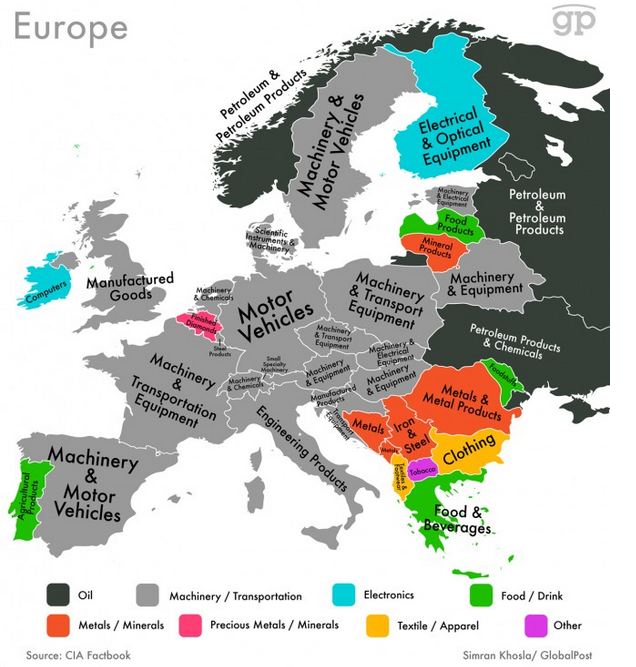
Most Important Exporting Good of Each Country

Which good is the most important exporting good of each county

Africa


Europe


North America


South America


Middle East


Asia


World (including Australia)


“These Maps Show Every Country’s Most Valuable Exports”, May 2014


World Flows of Natural Gas

The following Wikipedia map depicts the world exports of natural gas. With blue lines you can see the exports made through pipeline networks, and with red the exports of liquefied gas made by ships (LNG).
Map 1


The lines do not show pipelines or routes. They simply show flows of natural gas exports. Therefore you should only look at which country a line starts, and at which country the arrow points at. It does not matter which countries are crossed by the lines.

Exports through Pipeline Networks

Russia is the queen of exports through pipeline networks, as you can see from the three lines i.e. 136.2 billion cubic meters, 48.9 cubic meters, and 26.2 billion. I guess the line with the 136.2 billion cubic meters includes Norwegian exports too.

The Netherlands are the largest producer of natural gas in the EU, and it exports gas to the EU, but I guess the map treats the EU as a single geographical region and therefore it does not depicts exports made by the Netherlands.

Azerbaijan exports to Turkey 12 billion cubic meters, and Turkmenistan exports 27.4 billion cubic meters of natural gas to China and another 4.7 billion to Iran.

Algeria exports 30 billion cubic meters of natural gas to Europe. There is only one line from Algeria to Europe, but the line represents exports made by all the Algerian pipelines. Saudi Arabia exports 19.9 billion cubic meters of natural gas to Oman. It might actually be Qatar instead of Saudi Arabia. It is difficult to tell from the map.

Western Canada exports to East United States 78.9 billion cubic meters of gas, while another 25.8 b.c.m. of gas is exported from the eastern part of United States to the eastern part of Canada. The United States export another 18.6 billion cubic meters of gas to Mexico.

Bolivia exports 10.7 billion cubic meters of gas to Brazil.

Export of liquefied natural gas with ships (LNG)

Qatar is the king of LNG exports, with 35.4 billion c.m. to Japan, 29.1 billion to South Korea, 16.1 b.c.m. to India, 8.6 b.c.m. to Taiwan, and 23.8 b.c.m. to Europe.

Australia exports 35.8 b.c.m. of gas to Japan and 24.4 b.c.m. to China. Australia is increasing her production and in the near future she is expected to be the largest exporter of LNG, even though she is not one of the richest countries in reserves.  

Nigeria exports 5.6 b.c.m. of gas to Europe and 4.8 b.c.m to Japan.

Russia exports 11.6 b.c.m. to Japan.

Algeria exports 13.4 b.c.m. to Turkey and another 5.6 b.c.m. to Europe.

Venezuela exports 2.2 b.c.m. of LNG to Europe, 2 b.c.m. to USA and 3.6 b.c.m. to Argentina.

Indonesia or Malaysia, I cannot tell which one it is, since they are both exporters of natural gas, exports 6.7 b.c.m. of LNG to South Korea, 4 b.c.m. to Taiwan, and 15.1 b.c.m. to Japan.

I must repeat that you should pay attention to the first and last points of the lines. For example the line from Qatar to Europe i.e. 23.8 billion cubic meters, passes through Africa before reaching Europe, but it only refers to Europe. Moreover I might have made minor mistakes. The point is to get a general idea about who is selling to who and who is buying from whom. That’s what matters in geopolitics. The rest is about accounting.

Main European Pipeline Networks

The following map, even though not 100% accurate, depicts the most important European natural gas pipeline networks. These are the main arteries of course, and each artery has many branches which do not appear on the map.
Image 1


With yellow you can see the pipelines of Sonatrach, the Algerian state owned energy giant, with red you can see the pipelines of the Russian state owned giant Gazprom, and with green you can see the pipelines of the state owned Norwegian giant Statoil. Russia is Europe’s largest natural gas supplier, Norway is the second largest, Algeria is the third, Qatar is the fourth, Nigeria is the fifth, and Libya is the sixth, as you can see at the following table from Eurostat (for 2012).
Image 2


Sonatrach in Algeria, and Gazprom in Russia, have the exclusive right to export natural gas. That means they can cooperate with other companies in Algeria and Russia, but only they have the right to export Algerian and Russian natural gas.

Algeria
With yellow you can see the Maghreb-Europe Pipeline (Algeria-Morocco-Spain), the Medgaz  Pipeline (Algeria-Spain), the GALSI Pipeline (Algeria-Italy), and the Trans-Mediterranean Pipeline (Algeria-Tunisia-Italy). I must say that the GALSI pipeline, which is supposed to connect Algeria and Italy through Sardinia, Italy’s second largest island, has not been constructed yet. Moreover the Trans-Mediterranean Pipeline is not correctly sketched on the map, because it does not pass through Tunisia before reaching Italy.

Libya
With light green you can see the Green Stream Pipeline (Libya-Italy), which was inaugurated by Qaddafi and Berlusconi in 2004.

Norway
With greem you can see Europipe 1 (Norway-Germany), Europipe 2 (Norway-Denmark-Germany), Franpipe (Norway-France), Langeled (Norway-England), Scanled (Norway-Sweden-Denmark), which does not appear on the map, Vesterled (Norway-Scotland), and Zeepipe (Norway-Belgium).

Russia
With red you can see the Nord Stream pipeline (Russia-Germany), the Yamal-Europe pipeline (Russia-Ukraine), and the Blue Stream pipeline (Russia-Turkey). The Blue Stream pipeline which connects Russia and Turkey through the Black Sea did not appear on the map and I had to sketch it.

I do not know which one is the orange pipeline. Such a pipeline does not exist. Maybe it wants to show the effort made by the EU, Turkey and the US to connect the Caspian Sea with Europe through Turkey, but the pipelines that have been discussed so far i.e. Nabucco and TANAP-TAP, do not pass through the Black Sea. Maybe it is a pipeline that was considered in the past and it was later dropped, and I have not heard about it. The only pipeline networks which are discussed and do indeed pass through the Black Sea, are the Russian South Stream and the Turk Stream pipelines, both of which are having very hard times until now (September 2015), and they did not go ahead.

Today most of the revenue of the energy exporting countries still comes from oil. That is true even for Qatar, which is the 3rd richest country in the world in terms of natural gas reserves, and it is not even in the first ten richest countries when it comes to oil reserves. But natural gas is growing in importance because it is friendlier for the environment. Moreover when natural gas is sold though pipelines it creates geopolitical addictions, because these networks are very expensive and require huge investments. Therefore before such networks are built, the selling and buying countries always sign long term agreements which significantly affect their foreign policies. You see how the Russo-German pipelines have affected Germany’s behavior as a NATO country.

Moreover when a natural gas pipeline network is constructed it is very difficulty to import liquefied natural gas (LNG), because LNG is very expensive. LNG must be converted to liquid form in the selling country’s facilities, in order to be carried by special and very expensive ships, and when it reaches the buying country it must be converted to its original form before it can be used. This process involves very large costs. On the contrary a pipeline network is very expensive to construct, but once constructed it does not involve significant costs to carry the gas from the selling to the buying country.

Finally the oil market is a very old and a very well organized market, and prices are determined each day internationally by demand and supply. When the price is 50 dollars per barrel everybody sells for 50 dollars. When the price is 150 dollars everybody sells for 150 dollars. That is not the case for natural gas. Natural gas prices are agreed between individual sellers and buyers, and buyers can charge lower prices to friendly governments, and higher prices to non-friendly governments. That’s what the European Union is accusing Russia of doing to the countries of the EU.

What we definitely see happening is that while oil was the main cause of war in the 20th century, natural gas has been the main cause of war in the beginning of the 21st century. Oil is still a very important cause of war, but the importance of the role of natural gas in international warfare has dramatically increased.


Δευτέρα 14 Σεπτεμβρίου 2015

Is Turkey Heading Towards a Civil War?

Very nice article by Al Monitor, titled “Ιs Turkey heading toward civil war?”, September 2015, which wonders whether Turkey will manage to avoid a civil war at South East Turkey i.e. Turkish Kurdistan. If Turkey indeed goes to a war with the Kurds of PKK in East Turkey, who are wholeheartedly supported by Russia, Russia will be the big winner. The war in Syria prevents the Qatar-Turkey gas pipeline, which would hurt Gazprom in Europe, and the war in East Turkey will bury the Southern Energy Corridor. The German-Russian pipelines through the Baltic Sea will be the only safe options. Russia wins.
Map 1


Algeria, where the state owned Sonatrach could send her natural gas to Europe, through the Maghreb Pipeline (Algeria-Morocco-Spain) and the Trans-Mediterranean Pipeline (Algerian-Tunisia-Italy), together with the Nigeria’s gas through the Trans-Saharan pipeline, is not likely to make it. The Nigerian gas has to pass Boko Haram in order to reach Algeria, and the Algerian gas needs Morocco and Tunisia to reach Europe. There are many terrorist attacks in both Morocco and Tunisia, because the Algerian gas hurts Turkey, it hurts Russia, it hurts Iran, it hurts Qatar, it hurts Saudi Arabia, it hurts all the international terrorists. And when all terrorists are united you have a big problem.

Therefore for the moment Russia seems to win big. But will Turkey give up, or will she attack the Russian pipelines in Germany, where there are many islamists influenced by Turkey? If Turkey attacks Russia in Germany, she will attack Germany too, and that will take the game to the next level, because Russia and Turkey are international terrorists, but Germany is not. Will Turkey dare to bring the war in the European Union? If she does it will be a new day.


At the following articles you can read about terrorism in Morocco and Tunisia.

“Ιs Turkey heading toward civil war?”, September 2015

“Morocco placed on high terror alert by Foreign Office with travellers urged to be 'vigilant'”, September 2015


“Tunisia terror attack: 30 of 38 people killed are British, UK says”, July 2015


The Dictator of the Rich in Oil and Uranium Kazakhstan

Nursultan Nazarbayev is the President of Kazakhstan. Kazakhstan is one of the richest countries in the world in terms of oil and uranium reserves. Nazarbayev is a Muslim of Turkic origin, like most of the people of Central Asia (Kazakhstan, Turkmenistan, Tajikistan, Uzbekistan, Kyrgyzstan). However for as long as the countries of Central Asia were Russian colonies, that is until 1991, Nazarbayev was a communist atheist, because that’s what Russia demanded, in order to prevent the Arabs, the Iranians and the Turks from using Islam to gain influence in her colonies.

However things changed after the collapse of the Soviet Union. Nazarbayev, who was the General Secretary of Kazakhstan’s communist party, and he knew how to “move” around, became Kazakhstan’s President, a post that he holds to this very day (September 2015). Kazakhstan does not want to depend on China for its oil exports, and wants to send its oil to Europe too, through Turkey. However Kazakhstan has to take Russian threats seriously before selling oil to Europe, which is Russia’s major client. Putin has declared that there was never a country called Kazakhstan, making clear what will happen if Kazakhstan decides to send its oil to Europe.
Map 1


Nazarbayev is trying to have good relations with Russia, because Russia has the military advantage in the region, but he is no longer the atheist communism he once was, and he is promoting Islam, in order to come closer to Turkey. Nazarbayev counts on Turkey’s help to counter the Russian threats and send Kazakhstan’s oil to Europe. Turkey is in very good terms with Kazakhstan and Turkmenistan, which both need her to counter the Russian threats and export their oil and natural gas to Europe, but she has problematic relations with Uzbekistan, because Uzbekistan wants the oil and natural gas of the region to move eastwards in order to pass from Uzbekistan.

With Tajikistan Turkey does not have strong relations, because Tajikistan is close to Iran, but Turkey has good relations with Kyrgyzstan, because the pipelines pass through Uzbekistan and not through Kyrgyzstan before reaching China. Therefore Kyrgyzstan does not have much to lose. However Turkmenistan, Uzbekistan and Kyrgyzstan are now talking about a pipeline through Turkmenistan, Uzbekistan and Kyrgyzstan to China. If this pipeline is constructed at some point the relation between Turkey and Kyrgyzstan might be affected.

There are three major influences in Central Asia. Russia’s military influence, China’s economic influence, and Turkey’s cultural influence (Islam). Some people call Central Asia the Middle East of the 21st Century. Nursultan Nazarbayev is dancing between communism and Islamism because he wants to sell the oil of his country to both the East and the West. As you can read at the following Bloomberg article, Nazarbayev has appointed his daughter as the deputy Prime Minister, because he wants her to succeed him in Kazakhstan’s leadership. Communists and Islamists have something in common. They are not very democratic.

“Kazakh Leader Names Daughter to Cabinet With Succession in Focus”, September 2015


Κυριακή 13 Σεπτεμβρίου 2015

The Great Advantage of the Russo-German Pipelines and the Jihadists

The Russo-German pipelines i.e. Nord Stream and Nord Stream 2, have an advantage that no other European gas pipeline has. They are very safe. As you can see at the following map, from the 7 choices that Europe has at her disposal when it comes to natural gas pipelines, the Russo-German pipelines are by far the safest ones.
Map 1


Number 1 shows the Norwegian state owned Statoil, which is the second largest natural gas supplier of Europe, with the Russian state owned Gazprom being the largest supplier. Statoil and Norway is a very safe option, but Norway does not have adequate natural gas reserves and her production is falling. Number 2 represents the Russo-Germany pipelines (Nord Stream). Number 3 represents the route of the Russian gas through Ukraine, which is not a safe one, since Russia is fighting with the EU and the US about whether Ukraine will belong to the EU and NATO or not. There is a war in Ukraine. Number 4 is the route through Turkey, which is not safe either, because Russia is attacking it through the Turkish Kurdistan and Syria. Number 7 represents the East Med Pipeline, which is supposed to send Israeli, Cypriot and Egyptian gas to Europe through the East Mediterranean Sea. This route is not safe because it will be attacked by Turkey and Iran, if ever constructed.

Number 5 is the Libyan Green Stream gas pipeline, which is already operating. This is not safe because there is war in Libya, and Libya is very rich in oil but not very rich in natural gas. Number 6 represents the Algerian pipelines Maghreb-Europe (Algeria-Morocco-Spain) and Trans-Mediterranean Pipeline (Algeria-Tunisia-Italy), plus the Trans-Saharan Pipeline, which will supposedly send Nigerian natural gas to Algeria and Europe. The two Algerian pipelines offer some safety at the time, since Algeria managed to escape the Arab Spring, but nobody can guarantee that the Algerian socialists and islamists will not go to war at some point, since there is already tension among them. Moreover these two pipelines require stability in Tunisia and Morocco, and there is tension in these two countries amd many terrorist attacks. As far as the Trans-Saharan pipeline is concerned, it would have to pass through ISIS’s subsidiary Boko Haram before it managed to reach Algeria in order to send Nigeria’s natural gas to Europe.

Therefore for Europe the only safe solution are the Russo-German pipelines i.e. Nord Stream 1 and Nord Stream 2. That’s not good for Europe. But that’s how things are. The Baltic route is currently the safest route. Unless of course Islamic countries support Islamist terrorists who will sabotage these pipelines, and will deprive them from their great advantage i.e. their safety. There is tension between Germany and Turkey, because Turkey wants to become the entry point for natural gas to Europe, and the Russo-German cooperation is hurting her, since it sends so much gas to Europe through Germany, soaking demand. The Islamist Turkish President Tayip Erdogan urges Germans of Turkish origin not to assimilate in Germany, as you can read at the following Spiegel article.
“Erdogan Urges Turks Not to Assimilate: 'You Are Part of Germany, But Also Part of Our Great Turkey”, February 2011

Moreover, as you can read at the following Yahoo article, titled “Islamists in Germany trying to recruit young refugees”, September 2015, Islamists are doing a good job in recruiting young poor immigrants.

As you can read at the following BBC article, titled Islamic State militants 'smuggled to Europe, May 2015, ISIS uses refuges to smuggle fighters into Europe. According to the BBC ISIS is controlling the smugglers, and is charging a fee.

The socialists of Southern Europe, both red and black, threaten the Northern Europeans that they will send them jihadists if they don’t give them more money, as the Greek Defense Minister did, as you can read at the following Telegraph article, titled “Greece's defence minister threatens to send migrants including jihadists to Western Europe”, March 2015.

Mateo Renzi in Italy opened Italy’s borders in 2014, causing an amazing influx of illegal immigrants to Europe. Then in 2015, SYRIZA, the Greek party which won the Greek elections in January 2015, opened the Greek borders too, making things even worse for Europe. As you can read at the 13th paragraph of the following Guardian article, titled “Migrants locked in stadium on Kos for nearly 24 hours”, August 2015, 30.000 illegal immigrants entered Greece in 2014, under the center-right government of Antonis Samaras. At the 5th paragraph of the following BBC article, titled “Migrant crisis: Thousands arrive in mainlandGreece”, September 2015, under the new leftish government, 23.000 illegal immigrants entered Greece only in the first week of September 2015.

“Migrants locked in stadium on Kos for nearly 24 hours”, August 2015

 “Migrant crisis: Thousands arrive in mainland Greece”, September 2015

For the Greek left there is a lot to win by opening the Greek borders. It punishes Northern Europeans who ask for reforms before giving more money to Greece. The corrupt political system of Greece does not like that. By opening the borders this rotten political system takes its revenge. Moreover countries like Saudi Arabia, Qatar, the United Arab Emireates and more, are paying lots of money to promote Islamism in Europe. France made the same mistake and the French paid it with their blood. See
“France to cut Qatar funding of mosques in crackdown on islamic fundamentalism”, February 2015.

The thing is that the Russo-German pipelines are already reaching Germany and the Czech Republic (OPAL pipeline), and Germany and the Netherlands (NEL pipeline), and there are discussions to reach Great Britain through the Netherlands. They already reach France too. That’s a big disaster for Turkey, Iran and Qatar. You should not believe that the socialists of Southern Europe are opening their countries’ borders for nothing. There is a lot of money involved, and they will also gain voters in the future, and they are taking their revenge from Northern Europe. And the countries who bribe European socialists don’t do it for nothing either. There is a lot more to immigration than it seems to be.

For Mateo Renzi see the following article by the National Geographic. Mateo Renzi became Prime Minister of Italy in February 2014, and there was an increase of 823% in the influx of illegal immigrants in the first quarter of 2014 (Jan-Feb-March-April) compared to the same period in 2013. What Mateo Renzi did in Italy in 2014, and Alexis Tsipras did in Greece in 2015 were no mistake.
“Amid Record Waves of Refugees, Italy Finding Limits to Its Compassion”, October 2014
10th Paragraph
Boot-shaped Italy, uniquely exposed in Europe because of its long, meandering coastline and numerous islands, is often seafaring migrants' point of entry into Europe. The country leads the continent in arrivals by sea, which, in the first quarter of 2014 alone, increased by 823 percent over the same period in 2013. For many, though, Italy is a waystation to other EU countries.

 Below you can see the richest countries in natural gas reserves.
Table 1


Παρασκευή 11 Σεπτεμβρίου 2015

From Dagestan to Syria

At the following Business Insider article, titled “ISIS has claimed responsibility for an attack on Russian military barracks”, September 2015, you can read that ISIS made its first appearance in Dagestan in June 2015, but did not pull any terrorist attacks until September 2nd 2015, when it claimed responsibility for the attack to a Russian military barrack. Many Russian soldiers were wounded and dead from this attack. Dagestan and Chechnya are two of the most problematic regions of Russia, because almost all of their populations are Sunni Muslims.

Map 1


In September 2015 we learned about the deal for Nord Stream 2, between Gazprom and BASF (Germany), E.ON (Germany), ENGIE-ex GDF Suez (France), OMV (Austria), and Shell (England-Netherlands). This deal will increase the amount of Russian gas which can be transferred to Europe through Germany from 55 to 110 billion cubic meters per year. In September 2015 we learned that Turkey is freezing negotiations with Russia about the Turk Stream Pipeline, which would transfer Russian gas to Europe through Turkey. In September we learned that ISIS carried out its first attack in Dagestan, and it is widely believed that Turkey has significant influence over ISIS. In September 2015 we learned that the Russians significantly increase their military presence to Syria, in order to further support the Syrian dictator Bashar al Assad, who is one of Turkey’s main opponents, since in 2009 he blocked the Qatar-Turkey natural gas pipeline, in order to protect the Russian economic interests in Europe.

From Dagestan to Syria, and from Nord Stream 2 to Turk Stream, we are witnessing the same energy war between Turkey and Russia. The two great opponents of the Balkans, of the Black Sea, and of Central Asia. The Ottoman Empire and the Russian Empire. The other two players of this story, the German Empire and the Austro-Hungarian Empire, after their defeat in WW2, they prefer not to exercise their military influence, and they suffice themselves to their economic influence, scared of what might happen if they stretch their military muscles.

For more details about the energy war between Russia and Turkey see "Russia VS Turkey: The Geopolitics of the South & the Turk Stream Pipelines".

For the Business Insider article see
“ISIS has claimed responsibility for an attack on Russian military barracks”, του Σεπτεμβρίου 2015