Τρίτη 26 Ιανουαρίου 2016

The Geopolitics of Anti-Semitism

After Putin, who openly accused Turkey for cooperating with ISIS, the Israeli Defence Minister said today that ISIS is funded with Turkish money. See Yahoo “Islamic State 'enjoyed Turkish money for oil': Israeli minister”, January 2016

I guess what the Israeli minister said does not help the efforts for the normalization of the Turkish-Israeli relations. Actually it could be an Israeli move which aims to prove to the Russians on whose side the Israelis are on the Russian-Turkish confrontation. It can’t be a coincidence that a few days ago Vladimir Putin called the Jews who feel threatened by the rise of anti-Semitism in Europe to find shelter in Russia. See Yahoo “Vladimir Putin calls for Jews to emigrate to Russia amid increasing anti-Semitic violence in Europe”, January 2016

This is a great change, because it was always the Ottomans (Turks) who were saving the Jews from the hatred of the Europeans during the previous centuries. The European Christians believed it was a sin to lend money, and they had the European Jews doing it, who were a minority and whom they perceived as inferior to Christians. When European aristocrats went bust, and owed large sums to Jewish bankers, they would organize persecutions against the Jews, in order to kill them and clear their debts.

Map 1


The Ottomans wanted to organize a banking system, and they welcomed the Jews that were hunted by the Europeans. Moreover the Ottomans were much more relaxed towards other religions than we think they were and they respected the Jewish religion. After World War 2, even though Hitler killed the Jews of Europe, and those who were not killed fled to America and Israel, the Russians and the Arabs paid large sums of money to European socialists, in order to promote anti-Semitism.

The Arabs were doing it because Israel was a thorn in their eye, both because of its alliance with Iran until 1979, and also because it blocked the Arab exit to the Mediterranean Sea. The Russians were doing it because they were allies of the Arab socialist dictators in Algeria, Libya, Egypt, Iraq and Syria. But European socialists also needed someone to blame for their inefficiencies.

The sacred book of all Nazi organization i.e. “The Protocols of the Elders of Zion”, which claims that everything bad is a Jewish conspiracy, was published in Tsarist Russia at the beginning of the 20th century. Russia was one of the centers of anti-Semitism during the 20th century, and it was from Tsarist Russia that Jews fled to Germany during the 19th and 20th centuries, which at the time was a capitalist and free country, in order to be later killed by Hitler.

As long as the national socialists (Kemalists) were ruling Turkey, Turkey kept protecting Israel and the Jews during the 20th century. That came to an end with the rise of the Islamsits in Turkey in 2003. The Turkish Islamists placed great emphasis on the war against Israel, in order to become the leader of the Sunni world. During the late years the war against Israel was a great advantage for the Iranians, since the Turks were an Israeli ally, and the Saudis, even though they never recognized Israel, had to cooperate with Israel against Iran, which is the greatest enemy for both of them. Moreover the Turkish Islamists follow a very aggressive energy policy, and Syria, Lebanon, Israel and Egypt are energy routes that can connect the Middle East to Europe bypassing Turkey as an energy hub.

Actually it was in Erdogan’s Turkey that the sequel of “The Protocols of the Elders of Zions” was published in the 21st century, approximately 100 years after the publication of the Protocols of the Elders of Zion in Tsarist Russia.. See Al Monitor “Unraveling the AKP's 'Mastermind' conspiracy theory”, March 2015.

Now we see the Russians and the Israelis united against a common enemy i.e. the rise of Sunni Islamism. It is too early to tell how the Turkish-Israeli, the Russian-Israeli, but also the Turkish-Russian relations will develop. But it is already a great change to see the Turks becoming more anti-Semitic than the Europeans, and to see the Russians, who were more anti-Semitic than the Europeans, to invite to Russia the Jews who feel threatened by the rise of anti-Semitism in Europe.


Κυριακή 24 Ιανουαρίου 2016

France VS Muammar Gaddafi

Muammar Gaddafi’s Libya had economic relations with France, because Southern Europe is the ideal importer of Northern Africa’s raw materials. But there was also traditional rivalry between the two countries, because Colonel Gaddafi did not like France’s great influence over North Africa. One of the thorns in the French-Libyan relations was that Libya wanted to annex the rich in uranium Aouzou Strip at the Libyan-Chad borders.

France imports most of her uranium from North Africa, and France and Gaddafi were at the opposite sides during the wars between Libya and Chad and during Chad’s civil war. Libya managed to annex the Aouzou Strip in 1976, but Chad’s army pushed the Libyan army away in 1987, I guess with French support too.

Map 1 Aouzou Strip


I guess that Gaddafi was not happy with the French present in Niger either. France gets most of her uranium from Niger.

Map 2


It is not a coincidence that when in 2011 the Arab Spring broke, the French were the first ones to attack Gaddafi. Sometime before the attack, during his public appearances in Libya, Gaddafi was saying that he had given money to Sarkozy, and that Sarkozy was a retard.


The alliance between Gaddafi, Berluskoni and Putin at the time definitely played a role in France’s decision to attack Libya. It was the time that Berluskoni and Putin had agreed on the South Stream Pipeline, and the Italian ENI would get a larges take in this project. The Italian public is ENI’s largest shareholder. Now things have changed, because the South Stream Pipeline has been cancelled, and it was replaced by the Nord Stream 2 Pipeline. In Nord Stream 2 the Russians gave a stake to the French (ENGIE) but they left the Italians out (ENI), and the Italians are not very happy. 

Σάββατο 23 Ιανουαρίου 2016

Putin - Assad Part 2 : A Review of the Geopolitics of Syria

Yesterday I uploaded a Financial Times article which revealed that Putin asked the Syrian dictator Bashar al Assad to consider stepping down. See “Vladimir Putin asked Bashar al-Assad to step down”, January 2016

Someone might have just read the title, and think that this happened yesterday, and expect Assad to go in a couple of days. But that’s not at all how the story goes. According to the Financial Times, Igor Sergun, a Russian General, was sent by Putin on the 3rd of January 2016 in order to ask Assad to consider stepping down, in order for a solution to be reached in Syria. Remember that almost at the same time the Russians said they could offer Assad asylum. See Guardian “Putin hints that Russia could grant asylum to Assad”, January 2016.

The article is not important because it says that Assad will go, because that’s not at all what it says. Actually the Financial Times writes that the Russians deny that they suggested to Assad that maybe it is time for him to go. The article is important because it confirms what we already know about Syria. And what do we know so far? We know that it would be good for Russia if Assad stepped down, because Bashar al Assad is the main Iranian ally in the Middle East, and his removal would calm the Turks and the Arabs of the Gulf.

Therefore the war between Russia on one hand and the Turks and the Arabs on the other could cool down with Assad gone. The reason is that the Turks and the Arabs could accept Russia as a second best solution in Syria, in order for Russia to guarantee that the Iranians and the Iraqis will not export oil and gas to the Mediterranean Sea through Syria. If the Iranians and the Iraqis were to do that they would create competition for the Arabs and the Russians in Europe, and they would also bypass Turkey as an energy corridor.

Map 1 The War for the Pipelines


But as I have already said if the Russians were to consent to Assad’s fall, the Iranians could decide to send oil and gas to Europe through Turkey to retaliate. On the contrary, as long as the Russians help Assad to stay in power, the Iranians will prioritize sending their oil and gas to China through Pakistan, and to India through Oman, in order to avoid India’s main enemy i.e. Pakistan. That way the Iranians would not hurt the Russian interests, since Russia does not sell natural gas to China and India. Russia has signed some agreements with China but it is very doubtful that they will come to life. They were mainly meant to scare the European Union.

Therefore the Financial Times article is important as a confirmation of what we already know, and not as a prediction of what will follow. Assad would go any time Russia decided so. Russia would not even have to overturn Assad herself. Russia could simply withdraw her forces from Syria, and Assad would fall, because the Iranians could not stop the Turks and the Arabs without the Russians. Obviously the Russians are not willing to let Syria fall in the hands of the Turks and the Arabs, because they would construct the Arab-Turkish pipelines, for example the Qatar-Turkey pipeline that the Arabs and the Turks agreed on in 2009, and which was blocked by Assad in Syria. Assad blocked the Qatar-Turkey pipeline in order to protect the Russian and Iranian interests, and agreed to the Iran-Iraq-Syria pipeline, which would be constructed and managed by Gazprom.

I would like to make a summary of the major economic interests in Syria, because the main interests are really straightforward, and they tell the whole story in Syria. The problem is that they are moving in ways that make it very difficult to reconcile.

Russia : Russia’s first priority is to prevent the Arab-Turkish (Sunni) Pipelines, and also to prevent the Iran-Iraq-Syria (Shia) Pipelines. The second Russian priority is to construct and manage the Iran-Iraq-Syria pipeline if one of the two must definitely go ahead.

Iran: The Iranian dream has always been to reach the Mediterranean Sea and export their oil and gas to Europe. It has been centuries since the Iranians do not have access to the Mediterranean Sea.

Iraq: The Shia Arabs of Iraq, who are the majority of Iraq and came to power after the Americans overtunred the minority of Sunni Arabs (Saddam Hussein) who were running Iraq, are competing with the Iranians in the Persian Gulf, because they are both oil and gas exporters. However in Syria the Shia Arabs of Iraq, whom we called the “Government of Baghdad”, are supporting the Iranians.

The Iraqis agreed to allow the Iranians to send their oil and gas to Syria and the Mediterranean Sea through Iraq, in order for the Iranians to allow the Iraqis to send their oil and gas to the Mediterranean Sea through Syria, which is a very strong Iranian ally. However the Iraqis and the Iranians are not natural allies. Probably the opposite is true, and if at some point the Iraqis believe that they have more chances to export their oil and gas to Europe or Turkey through the Sunni alliance, they could change sides. But for now the Shia Iraqis are supporting the Iranians in Syria.

Turkey: Turkey wants the Arab-Turkish pipelines to go ahead and also Turkey wants to block the Iranians and the Iraqis from reaching the Mediterranean Sea, because they would bypass Turkey as an energy hub. Turkey wants free elections in Syria, in order for the Sunni minority to rise to power, something that would open Syria’s door to Turkey. Turkey wants Syria to become a Turkish satellite, since Turkey is the strongest military power of the Muslim world.

The Arabs of the Persian Gulf : In Syria the Arabs of the Persian Gulf have almost the same interests with the Turks. The Arabs want the construction of the Arab-Turkish pipelines, and also to block Iran’s exit to the Mediterranean Sea. However the Arabs would prefer Syria under Arab rather than Turkish influence, but they would definitely prefer Turkish than Iranian influence over Syria, because Turkey does not have oil and gas to export through Syria.

The United States: Syria is not very important for the United States, because she is poor in oil and gas. The rich in oil and gas Iraq is a lot more important for the Americans, and that’s why the Americans care a lot more for their Shia Arabs allies in South Iraq, and their Kurdish allies in Northern Iraq. Both of these American allies are very rich in oil and gas. In Syria the Americans support the Kurds, the Turks and the Arabs support the Syrian Sunni Islamists, and the Russians and the Iranians support the Syrian Alawites of Bashar al Assad.

In Syria the Americans are attacking the Sunni Syrians who are supported by Turkey when they attack the Syrian Kurds, and to make things up to Turkey they support Turkey against Russia in Syria. That’s why the Americans are asking for Assad to go. But the Americans are calling for Assad to go with less and less enthusiasm. Erdogan’s Turkey is not the ally she used to be for the United States, and I think that for the United States it would be much better if the Iranians controlled Syria rather than the Turks. The Americans are already too heavily dependent on Turkey, and I do not think they would be very happy to see their dependency on Turkey rising. But it does not seem realistic to expect the Iranians to control Syria. Probably the Alawite part of Syria will be controlled by Russia, and the Sunni part of Syria will be controlled by the Turks and the Arabs of the Gulf.

For the United States the best scenario would be for all the pipelines to go ahead i.e. the Arab-Turkish Pipelines (Qatar-Turkey), the Iran-Syria Pipeline (Shia Pipelines), and the Caspian Sea-Turkey-Europe Pipeline (Southern Energy Corridor), in order for no one to have too much influence over the American allies in Europe. But this scenario is a midsummer night’s dream.

China: For China, Syria is not very important either. Iraq is important for China. For China and the United States oil and gas rich countries like Iraq are always more important than oil and gas poor countries like Syria. On the contrary, for the oil and gas rich Russia the importance is not on the oil and gas but on the corridors of oil and gas. Iraq is a source of oil and gas and interests more the US and China, and Syria is a corridor for oil and gas and interests more Russia.


What is important is that the economic interests in Syria are very straight forward, and you can know what is happening in Syria simply by looking at the map I provide above. The problem is that these straightforward interests are moving in very opposite directions, and are very difficult to reconcile. But articles like the one from the Financial Times cannot tell us something that we do not already know about Syria, because things in Syria are already pretty simple.

Παρασκευή 22 Ιανουαρίου 2016

A Sunni Alliance?

Very good article from Stratfor about Saudi Arabia’s efforts to reconcile the Turkish Islamists and the Egyptian socialists, in order for the two countries to join the Sunni alliance promoted by Saudi Arabia against the rise of Iran. I must say that the Saudis are paying a very high price for their “friends”. As you can see at the following table from Statfor, Saudi Arabia has the smallest population of the three countries, but she has by far the largest GDP (income) per inhabitant.

EgyptSaudi ArabiaTurkey : A Comparison


The main problem for the Saudi-Turkish-Egyptian alliance is that the three countries have different priorities. Iran is the main problem for Saudi Arabia, Russia is the main problem for Turkey, and Turkey is the main problem for Egypt. Therefore the main problem is the Turkey-Egypt relation. But the discovery of the Zohr natural gas field in August 2015, which is the largest gas field of the East Mediterranean Sea, made Turkey a potential importer of Egyptian gas. That can certainly help Turkey and Egypt to reach some kind of agreement. Besides the gas deals, both Turkey and Egypt want the Saudi money.

Stratfor says that Turkey might have to accept the socialist government of General Sisi in Egypt, and in exchange the Egyptian socialists might have to “cool” their stance towards the Egyptian Islamists.

“A Sunni Alliance Creates Strange Bedfellows”, January 2016

Τετάρτη 20 Ιανουαρίου 2016

How the Biased Western Media Presented the Misleading Oxfam Inequality Report

I often accuse the main Western media of the left and the center-left for bias on economic issues i.e. The Guardian (England), The New York Times and The Washington Post (United States), Le Monde and Liberation (France), El Pais (Spain) etc. I also praise the liberal (center-right) newspapers i.e. The Financial Times and The Wall Street Journal. Yesterday I uploaded a critique for the Oxfam inequality report and the 62 richest people in the world. See “Oxfam’s Misleading Report about Inequality and the 62 Richest People in the World”.

Except of attacking Oxfam, which is a leftist organization, the Oxfam Report is very useful to also demonstrate the propaganda of the leftist western media, and that’s why I am writing this post.

However, before attacking the Western media, I would like to add one more point, one point that I failed to mention in the critique I uploaded yesterday. The point is that approximately thirty six percent (36%) of the poor and relatively poor people included in the Oxfam Report are Chinese and Indians, since the two countries have a total population of 2.7 billion, and that is approximately 36% of the global population. The global population was approximately 7.4 billion in December 2015.

Note that China is a communist country, and India was almost a communist country, closely related to the Soviet Union, until the Soviet collapse in 1991. Therefore most of the poor people in Oxfam’s report come from communist or very socialist countries. You can also see the following data from Oxford University, which depicts extremely poor people by country. You can see that most of the extremely poor people are located in communist, ex communist or very socialist countries i.e. India, Nigeria, China, BangladeshCongo, Indonesia, Ethiopia, Pakistan etc.

Table 1 Absolute Poverty by Country


You can verify yourself what I say about the Chinese and Indian economies. I suggest that you start with Wikipedia. The following two Wikipedia links describe the India economy before and after the collapse of the Soviet Union i.e. “Economy of India: Pre-Liberalization Period 1947-1992”, and “Economy of India : “Post-Liberalization Period Since 1991”. See:

“Economy of India: Pre-Liberalization Period 1947-1992”

“Economy of India : “Post-Liberalization Period Since 1991”

India was an extremely poor country until 1991 and the collapse of the Soviet Union. After 1991 India decide to liberalize her economy a bit, she welcomed the Western companies, and she was significantly rewarded. China was also extremely poor until 1980, when she came to an agreement with the West, and Western companies entered and invested in China. China was also significantly rewarded.

Anyway, the point is that most of the poor people in Oxfam’s inequality report are Indians and Chinese i.e. people from communist or very socialist countries. Add to the poor Indians and Chinese the poor of other communist or socialist countries of Asia, Africa and Latin America.

Moreover the rich in Oxfam’s inequality report include the rich state-sponsored businessmen of the socialist countries, who are closely related to the political elite. Oxfam’s rich also include the members of the royal families of countries with monarchic regimes. Monarchies have nothing to do with capitalism and free markets i.e. Saudi Arabia, Qatar, United Arab Emirates etc.

Before you examine how the big Western media of the left and center-left used the Oxfam report in order to promote socialism, you need to truly realize how unreasonable it is to use the poor people of communist and socialist countries, and also the rich political elites of these countries, plus the rich monarchs of the world, in order to prove that more socialist is the solution, and that capitalism leads to increasing inequality.

In the articles of the New York Times and the Guardian that I provide below, you will read that the cause of inequality are the tax havens, the banking sector etc. They do not use the word capitalism and socialism explicitly, but they do not mention at all that most of the poor people come from socialist and communist countries, and therefore socialism might actually be the main cause of poverty and inequality. I think it is worth your time to read my critique, and then the NYT and Guardian articles. Not for the Oxfam inequality report, but to realize how state of the art propaganda is used against you.

I would also like to provide the following diagram from Oxford University. The diagram shows the dramatic decline of extreme poverty from 1820 to 2015. The cause of this dramatic decline in extreme poverty was the invention of capitalism in the 17th century.

Diagram 1


Read the articles, and then try to forget my critique about the Oxfam Report, and imagine how these articles would have affected the way you think if you hadn’t read any critique about the Oxfam Report. And note that critiques about the Oxfam Report are not widely available, while articles like the ones from the NYT and the Guardian are literally everywhere.

Articles

“Wealth Inequality Rising Fast, Oxfam Says, Faulting Tax Havens”, January 2016

“Richest 62 people as wealthy as half of world's population, says Oxfam”, January 2016

World Poverty


Δευτέρα 18 Ιανουαρίου 2016

American Imports and Exports

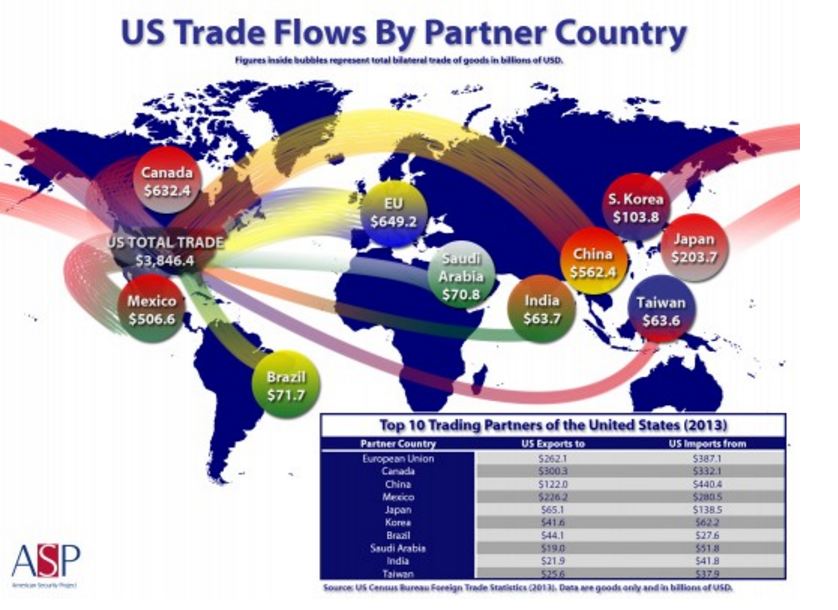
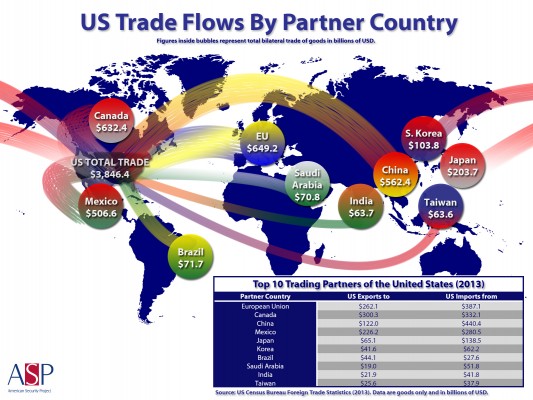
In 2013 the United States exported and imported goods worth 3.8 trillion dollars. Approximately 2.7 from these 3.8 trillions refer to imports and exports from and to the European Union (649 billions), Canada (632 billions), China (562 billions), Mexico (500 billions), Japan (200 billions) and South Korea (100 billons).

Map of American Exports and Imports (American Security Project ASP)


In 2014, with exports of American arms being at their peak, due to the wars in the Middle East and North Africa, the United States exported 36 billion dollars of arms to the rest of the world. See York Times “U.S. Foreign Arms Deals Increased Nearly $10 Billion in 2014”, December 2015. The 36 billion dollars are peanuts when compared to the American volume of trade with the rest of the world. The United States could export a lot more arms if they wished to, but they prefer to only sell arms to their allies.

As you can read in the 8th paragraph of the following Time article, in 2013 the United States spent 427 billion dollars for their oil imports. And keep in mind that the due to the new production techniques, that allowed production of oil from shale rock, the United States have overtaken Russia and Saudi Arabia as the largest producer of oil in the world. And still in 2013 the United States paid 427 billion dollars for oil imports.

There is a lot of propaganda for the arms sales. But if you compare the 36 billion dollars that the United States made from their arms exports with the 427 billion dollars that the United States paid for their oil imports you will see what determines international relations.

Articles

U.S. Foreign Arms Deals Increased Nearly $10 Billion in 2014”, December 2015
1st and 2nd Paragraph
Foreign arms sales by the United States jumped by almost $10 billion in 2014, about 35 percent, even as the global weapons market remained flat and competition among suppliers increased, a new congressional study has found.
American weapons receipts rose to $36.2 billion in 2014 from $26.7 billion the year before, bolstered by multibillion-dollar agreements with Qatar,Saudi Arabia and South Korea

“Why Are U.S. Oil Imports Falling”, April 2014
8th Paragraph
Despite increased domestic oil production and lower oil consumption, the US remains the largest importer of oil in the world, and spent $427 billion on imports in 2013.

Κυριακή 17 Ιανουαρίου 2016

The Khuzestan Province (Iran) and the Eastern Province (Saudi Arabia)

Map 1 shows the Khuzestan Province of Iran, map 2 shows the Eastern Province of Saudi Arabia, and map 3 shows the reserves of oil (black) and natural gas (red) of the region. Arab Shiites (Shia) are the majority in both Khuzestan (Iran) and the orange area of the Eastern Province (Saudi Arabia). As you can see from map 3 both regions are very rich in oil and natural gas reserves. The problem for Iran and Saudi Arabia is that the Iranians are Persian Shittes and not Arab Shiites, and the Saudis are Arab Sunnis and not Arab Shiites.

Map 1 Khuzestan Province


Map 2 Eastern Province of Saudi Arabia


Map 3 Reserves of Oil (black) and Natural Gas (red)


The Iraqis, mainly during Saddam Hussein’s rule, wanted to annex parts of Khuzestan by using the Arab Shiites of Khuzestan, and the Iranians, especially today, want to destabilize the Shiite parts of the Eastern Province of Saudi Arabia by using the Arab Shiites of Saudi Arabia. The Iraqis have the advantage over the Iranians that their agents in Khuzestan can promise everything to everybody, and the Iranians have the advantage over the Saudis that their agents in Eastern Province can similarly promise everything to everybody.

When the Iranian Islamists rose to power in 1979, and they nationalized the Western oil companies, destroying their alliance with the West, Saddam Hussein, who was a Soviet ally, grabbed the chance and invaded Iran, knowing that the West would not help the Iranians. Moreover Saddam Hussein knew that the Iranians scared the Arabs of the Persian Gulf more than him, and therefore the Arabs of the Gulf would have to support Iraq, because they would not want to see the Iranians bringing to power the Shiite majority of Iraq.

Note that Arab Shiites are the majority of Iraq, and Saddam Hussein ruled Iraq with the Sunni minority of the country. Exactly the opposite was going on in Syria, where the Alawite minority was governing the Sunni majority. Anyway, among other things Saddam claimed some parts of the rich in oil Khuzestan when he invaded Iran.

However Saddam Hussein failed to annex any regions of Iran during the Iraq-Iran War 1980-1989. Iran was mainly supported by China, North Korea, Syria and Libya. However the West, the Soviets and the Chinese did not get as much involved as the Arabs did. It was mainly the French who were selling arms to Saddam Hussein, and it was mainly the Arabs of the Persian Gulf who were paying for these arms. For the uprising of the Arab Shiites of Khuzestan after the Islamist Revolution of 1979, and also the Kurdish uprising of Western Iran during the same time, see Wikipedia “1979 Khuzestan uprising”.

Today we witness almost the same story happening in the Eastern Province of Saudi Arabia. Saudi Arabia has seriously hurt her relationship with the United States, and the Saudis have lost the American protection they enjoyed in the past. The Iranians feeling the Saudi weakness are supporting a revolt in the Shiite regions of Saudi Arabia. The Shiite cleric that was executed by the Saudis on January 2016, causing a deepening crisis in the Iranian-Saudi relations, was an enthusiastic supporter of the Shiite uprisings in 2011 when the Arab Spring broke out in Saudi Arabia. For the Shiite uprising in Saudi Arabia see Wikipedia “2011–12 Saudi Arabian protests”.


It is very interesting that the Sunni Arabs of Saddam Hussein and the Shiite Persians of Iran today are both using Arab Shiites. The first one was using them in order to attack Iran in the 80s, and the second ones are using them to attack Saudi Arabia in the 21st century. Today the official government of Iraq, which is controlled by Arab Shiites, has aligned itself with the Iranians, hoping that together they will manage to reach the Mediterranean Sea through Syria, which is an Iranian ally. That does not mean of course that the Arab Shiites of Iraq cannot change sides in the future, and align themselves with the Turks and the Sunnis, if they can send their oil and gas to Europe through Turkey.