Κυριακή 7 Φεβρουαρίου 2016

Why ISIS Prefers Turkey than Saudi Arabia

At the following map you can see the Sunni Arab (pink), the Shia Arab (green) and the Sunni Kurd (brown) parts of Iraq. Shia (Shiite) Arabs constitute the majority of Iraq. The red circle on the map is the only point of Iraq that reaches the Persian Gulf, as you can see at the following maps.

Map 1 Demographics of Iraq


Map 2


The following Wikipedia map is a more accurate map, because it also shows the Iraqi deserts. With intense gray you can see the Arab Shiite part (South Iraq), with somon you can see the Arab Sunni part (Western Iraq), with purple the Kurdish part, and with light gray the Iraqi deserts. The largest parts of the countries of North Africa and the Middle East are deserts and they are under populated.

Map 3


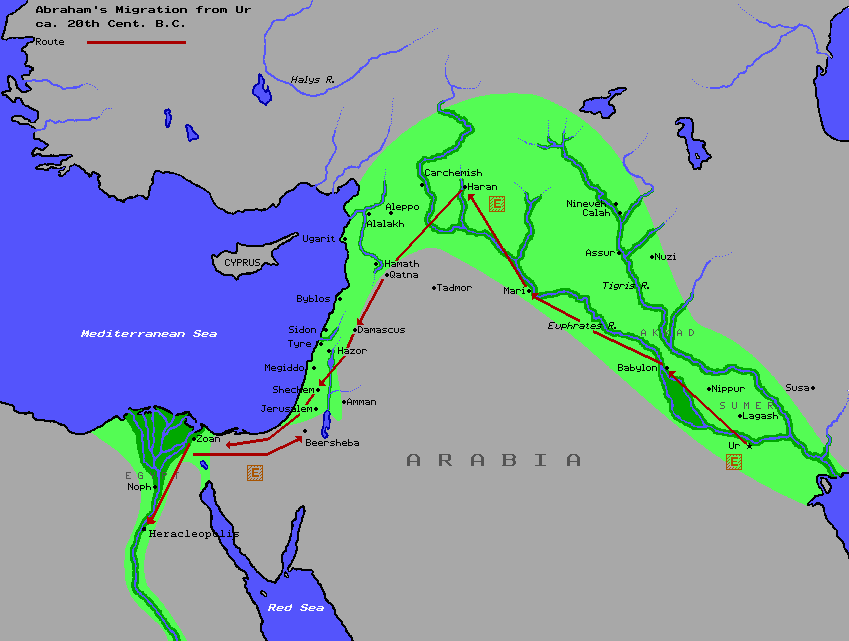
The following map shows Mesopotamia, the fertile region between the Tiger and Euphrates rivers. This region was the metropolis for the civilization of the Middle East, and actually more than that, and this happened due to these rivers and the connection with the Persian Gulf. Babylon was located near what today is Baghdad.

Map 4


Mesopotamia (Tiger and Euphrates Rivers), together with Egypt (Nile River), were the important regions when people were killing each other for water instead for oil, even though people are still killing each other for water. Turkey, Syria and Iraq had many disputes for the waters of Tiger and Euphrates even before the Arab Spring, because Turkey wants to use these waters for hydroelectric production. See for example “Ataturk Dam: Political Controversy”.

Map 5 Egypt and Mesopotamia (Nile, Tiger and Euphrates)


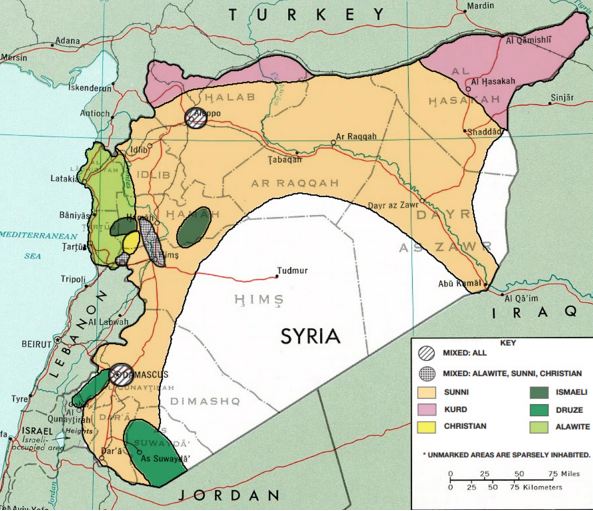
The following Wikipedia map shows the Sunni part of Syria (somon), the Alawite part of Syria (light green), the Kurdish part with pink, and the Syrian Desert with white.

Map 5


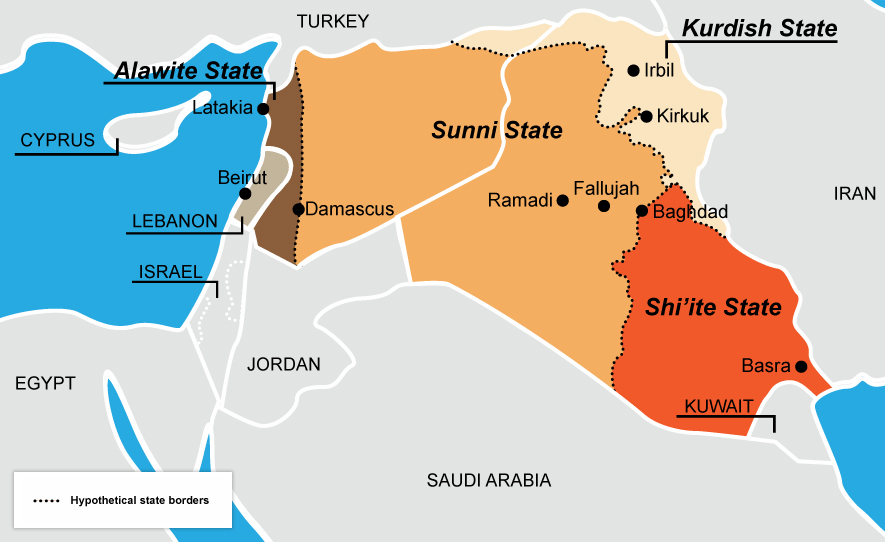
The following map is an approximation about how an Alawite (dark brown) a Sunni (light brown), a Shia (orange) and a Kurdish (beige) state could look like if at some point the war in Syria and Iraq ends, taking into account the demographics of Syria and Iraq. Of course this is only an approximation but reality should not look very different.

Map 6 Potential Alawite, Sunni, Shiite and Kurdish States in Syria and Iraq


When we talk about ISIS we mainly talk about the Sunni Islamists of Syria and Iraq, which are basically the parts of Syria and Iraq appearing with light brown on the above map. That’s why ISIS is so different from the terrorist organizations we knew until now. ISIS in Syria and Iraq looks like a regular army that has specific territorial claims, and it does not look like traditional terrorist organizations that worked for various socialist or Islamic governments.

That makes ISIS different from traditional terrorist organizations, but also different from some of ISIS subsidiaries in other countries, where local ISIS departments do not have territorial but only economic claims, and they have a traditional hit and run approach, rather than a regular army approach, which is the case for ISIS in Syria and Iraq. ISIS in Syria and Iraq even owns oilfields, and that makes ISIS the richest terrorist organization in history. Therefore we should not see ISIS as one thing, but more of an Islamic alliance or let’s say an Islamic NATO. In the same way that NATO members can cooperate when they have common interests, various ISIS branches can cooperate when they have common interests.

I must also say that in Syria and Iraq there are also Sunni socialists who prefer a socialist than an Islamic state, but the main power today in the Sunni parts of Syria and Iraq are the Sunni Islamists. See also “The So-Called Wars of Religion”.

I always say that even though we always talk about Turkey’s support to ISIS, we should not be misled to see Turkey and ISIS as the same thing, because they are very different things. Not even ISIS is one thing as I said. The Turkish Islamists, the Syrian Islamists and the Iraqi Islamists, are three different things. They just happen to have some common interests, and that’s why the Turks are supporting the Sunni Islamists of Syria and Iraq. But that does not make them one thing. They do not even have exactly the same interests. They just have some common interests, at least for now.

On map 6 you can see why ISIS of Syria and Iraq i.e. the Sunni Islamists of Syria and Iraq, prefer to work with Turkey rather than with Saudi Arabia. ISIS has oil, and it might have more oil in the future. Where can ISIS export this oil from? I guess it has to be Turkey. ISIS faces the Shiite Iraqis at the south, who are also oil exporters, and who are fighting the Sunni Iraqis i.e. the ex-people of Saddam Hussein. See “Saddam Hussein: The Father of ISIS in Iraq”.

Saudi Arabia is for ISIS another barrier. Saudi Arabia is also an oil exporter, and the Saudis had very bad relations with Saddam Hussein and his people, even though they were helping them against the common foe i.e. Iran. Remember that ISIS openly asked for the overturn of the Saudi King. See International Business Times “ISIS Vows War Against Saudi Arabia: Islamic State Group Threatens Arab Monarchy After Announcement Of Anti-Terror Coalition”, December 2015

In Syria ISIS faces the Russians and the Iranians behind the Assad regime, and ISIS knows that the Russians will not be willing to leave Syria, unless of course Assad asks them to. But if Assad asks them to go he would fall because the Iranians would not be able to save him from the Turks and the Arabs of the Gulf. Unless of course the American-Iranian relations improve so much, that the Americans replace the Russian protection to Assad. The following Foreign Policy article accuses Obama for betraying the Syrian rebels in order to help Assad, and the following Financial Times article says that Putin asked Assad to consider stepping down.


Vladimir Putin asked Bashar al-Assad to step down”, January 2016

But it is not so easy to make the Russians leave Syria, and even if they were replaced by the Iranians things would become worse for ISIS, because ISIS would face the Iranians, which is actually ISIS number one enemy together with the Shiites of Iraq. Even if Turkey was to control the Syrian coast lines she would not be pleased to see ISIS of Syria and Iraq exporting oil from Syria, which is very close to the Turkish port of Ceyhan, a major oil exporting point for Turkey. Therefore it seems that ISIS needs to export oil through Turkey, and that’s why you hear Putin and the Israeli Defense Minister accusing Turkey of financing ISIS by buying its oil. You never hear anyone accusing Saudi Arabia of buying ISIS oil. What would Saudi Arabia do with ISIS oil? Saudi Arabia is extremely rich in oil.


Also note that Turkey is much stronger in military terms than Saudi Arabia, and that is also very useful for the Syrian and Iraqi Sunni Islamists.

Τετάρτη 3 Φεβρουαρίου 2016

The Biggest Companies, the Richest People, and John Rockefeller

The following table from the Wall Street Journal shows the largest listed companies i.e. the largest companies traded in the stock markets. Therefore state companies, which are not traded in the stock markets, are not included in the list.

Wall Street Journal : Largest Companies


Companies are ranked according to market value i.e. number of shares X current share price. For example if a company has issued 1.000 shares, and at the moment each share sells for 2 dollars in the stock market, its value is 2.000 dollars. If there is some good news and the price of the share rises to 3 dollars, its value will be 3.000 dollars. If there is some bad news and the price of the share falls to 1 dollar its value will be 1.000 dollars, and so on. If we rank the companies according to some other criterion i.e. according to revenue or according to profits etc, we will end up with a different ranking.

As you can see Apple is number one, with a market value of 658 billion dollars. Alphabet, the second one, is Google. The table is from October 2015 and in the meantime the ranking has changed. Apple performed worse than expected and its price fell, and Google performed better than expected and its price rose. Now Google is number one with a market value of 570 billion dollars, and Apple is second with a market value 535 billion dollars. See Time magazine  “Google Overtakes Apple as the World’s Most Valuable Public Company”, January 2016.

I previously uploaded the list with the richest people in the world from Bloomberg. See “The Richest People on Earth”.

Bill Gates, the founder of Microsoft, is first on the list, with a fortune of 79 billion dollars. Mark Zuckerberg, the founder of Facebook, is fourth on the list, with a fortune of approximately 50 billion dollars.

Bloomberg Billionaires Index


As you can see the two lists are related. Bill Gates is number one and Microsoft is number three. Mark Zuckerberg is number four and Facebook is number 7. Jeff Bezos, the founder of Amazon, is number 5, and Amazon is number 10. The two lists cannot be completely related because different businessmen decide to hold different shares of their companies when they start, because they have different appetites for risk. Moreover these kind of businessmen create many companies. In addition, after a while, these guys are tired of all this money, and they start donating billions of dollars in order to build reputation as philanthropists, and also to feel good about themselves. Finally as time goes by fortunes change hands.

What we have to keep in mind is that most of these guys’ fortunes are not in the form of dollars in a box or bank deposits, but rather in the form of shares in their companies. Therefore if we want to tax more these billionaires that we see on the Bloomberg table, we do not have to open a box and take a few billions from the box, but rather we would have to tax their companies. We have to tax Microsoft more, we have tax Facebook more, we have to tax Amazon more etc, because that’s where most these peoples’ wealth is. If next year we stop using Facebook, and we start using something else, Zuckerberg will worth 5 billion and not 50 billion, because the price of his shares will collapse.

Moreover, many people who read communist and nazi propaganda are trying to find in the lists the names they hear in conspiracy theories i.e Rockefeller, Rothschild etc. The truth is that Bill Gates is the John Rockefeller of the 21st century, and John Rockefeller was the Bill Gates of the 20th century. Standard oil was the Microsoft of the 20th century, and Microsoft is the Standard Oil of the 21st century. If we were to read the same lists 100 years ago we would find John Rockefeller and Standard Oil instead of Bill Gates and Microsoft. And in 100 years from now we will not find Bill Gates and Microsoft in the lists.

However the company of John Rockefeller is still in the list, because Standard Oil was split to Exxon and Chevron, and as you can see Exxon is number four on the table. Except that it is no longer controlled by the Rockefellers. There might be some Rockefellers holding some shares in Exxon, but obviously their shares are peanuts when compared to the ones held by Gates, Zuckerberg etc, because Gates and Zuckerberg are the Rockefellers of the 21st centuries, and Rockefeller was the Gates and Zuckerberg of the 20th century.

I must also say that John Rockefeller was not Jewish as many people believe. John Rockefeller was Christian and a religious one. It was Mayer Rothschild , another legend, who was Jewish. But that’s not a problem. If you like conspiracy theories you do not need Rothschild. You can use Zuckerberg. Mark Zuckerberg is a Jew. For example you can say that through Facebook Zuckerberg controls our minds and our feelings etc. Or you can thing of something else. Think!

“Meet the Market Cap-tains: The $300 Billion Club, By the Numbers”, October 2015

The Richest People on Earth (Bloomberg)

The Bloomberg Billionaires Index monitors the richest people on earth. To see how much each billionaire is actually worth you need to go to the actual link and place the cursor on the relevant billionaire.


On February 3rd 2016 Bill Gates, the founder of Microsoft, is the richest man on earth, with a fortune of 79 billion dollars. Mark Zuckerberg (Facebook) overtook Jeff Bezos (Amazon) as the 4th richest man on earth with 50 billion dollars (Bezos 49 billion $). Second richest is the Spanish businessman and founder of the Inditex fashion group i.e. Zara etc Amancio Ortega Caona, with approximatelly 70 billion dollars. 3rd richest is the American businessman Warren Buffet with a fortune of approximatelly 60 billion dollars.

Bloomberg’s Billionaires

Τρίτη 2 Φεβρουαρίου 2016

Libya & Syria : The 2 Arab Allies of Iran

Muammar Qaddafi, or Gaddafi, became the dictator of Libya in 1969. Qaddafi continued the tradition of socialist dictators of North Africa and the Middle East, who overturn the pro-West monarchs and aligned their countries with the Soviet Union. Right from the start of his dictatorship Qaddafi started helping the other socialist dictators i.e. Gamal Nasser, Hafez Assad, Yasser Arafat etc, in their efforts to overturn the Iranian King i.e. the the Sah of Iran. The Sah of Iran was the strongest American ally in the Middle East. And as I have said in the past in 1968 the Iranians and the Israelis managed to construct the Eilat-Ashkelon Pipeline, after they had defeated the Arabs in the war of the 1967 i.e. the Six Day War.

With the Eilat-Ashkelon Pipeline the Iranians managed to overcome the Arab territorial blockade of Syria and Iraq, and the sea territorial blockade of Egypt and the Suez Canal, and reach the Mediterranean Sea and Europe through Israel. At the same time the Israelis were earning commissions, and they had access to oil, since the Arabs had not recognized Israeli and were not willing to sell oil to Israel. See “The Intra-Arab War for Oil 1950-1970”.

Map 1 The Eilat-Ashkelon Pipeline 1968


When the Iranian Islamists finally did overturn the Iranian Sah, and they nationalized the western oil companies, they no longer had the protection of the West. As I have already said in the past, Saddam Hussein grabbed the chance and invaded Iran, among other things in order to annex the rich in oil Khuzestan Province. For Saddam’s invasion of Iran and the Iran-Iraq War see “Saddam Hussein : The Father of ISIS in Iraq”.

But while all the Arabs, together with the Americans and the Soviets, were supporting Saddam Hussein and Iraq during the Iran-Iraq War, two Arab countries i.e. Libya and Syria, were supporting Iran together with China and North Korea.
  
Syria

The socialists Syrians, with Hafez al Assad as their leader, the father of the current dictator Bashar al Assad, supported Iran during the Iran-Iraq War of 1980-1988 because their efforts to form one country with Iraq in the 70s had failed due to Saddam Hussein’s rise to power in 1979. The Syrians had almost reached an agreement with Saddam’s predecessor Hassan al Bakr, in order for the two countries to become one, and export Iraqi oil to the Mediterranean Sea through Syria. However Saddam Hussein threaten al Bakr with a military coup and became president of Iraq. Saddam Hussein’s terms were much tougher than Bakr’s i.e. he wanted the Iraqi army in Syria before Syria and Iraq were to form a single country, something not accepted by Hafez Assad. See “Iraq-Syria Relations : Baathist Iraq and Syria”.

As a result a great rivalry was developed between Assad and Hussein, and the two men started accusing each other for allegedly plotting a coup against their regimes. Therefore even though both Syria and Iraq were Soviet allies, even though Iraq was very rich in oil and Syria was not, the two countries did not reach an agreement because it was difficult to decide how to split the power between the Syrians and the Iraqis.

Remember that Syria had already lost Egypt, when Egypt became an American ally in the 70s, and then also recognized Israel, and in 1979 Syria also lost Iraq with the Assad-Hussein rivalry. Therefore the Syrian Arabs decided to turn to Iran, both for funding against a common enemy i.e. Iraq, but also hopping that the Iranians would win the Iran-Iraq war, and the Shiite (Shia) Arab majority of Iraq would come to power. In that case the Iranians and the Iraqis could send their oil and gas to the Mediterranean Sea through Syria. Something that Gazprom undertook to do after many decades in order to block the Qatar-Turkey pipeline i.e. the Iran-Iraq-Syria pipeline.

Map 2 Pipelines Iraq-Syria and Iran-Iraq-Syria (1979)


Libya

Muammar Qaddafi on the other hand was an admirer and supporter of the Egyptian socialist dictator and Soviet ally Gamal Nasser. Gamal Nasser was threatening to block the Arabs of the Gulf from reaching the Mediterranean Sea through the Suez Canal, in order to ask for higher commissions and more influence for him over the Arab World. According to Nasser’s plan Egypt would conquer Israel and Syria would conquer Lebanon, and together they would totally block the Arabs of the Gulf. Nasser was trying to do what today Erdogan and Turkey are trying to do to the Arabs of the Gulf.

Gamal Nasser’s aggression towards the Arabs of the Gulf was quite convenient for Qaddafi, because the Gulf countries were his competitors in the European oil markets. Moreover Saudi Arabia was a US ally and it was much harder to jointly reduce oil production in order to increase prices. When Anwar Sadat succeeded Gamal Nasser as the Egyptian socialist dictator, and decided to steer Egypt towards the United States, Libya and Egypt went to war i.e. the Libyan-Egyptian War of 1977. Egypt and Libya broke diplomatic ties for many years. For the Egyptian-Libyan War of 1977 see Wikipedia “Libyan-Egyptian War”

Anwar Sadat was Egypt’s number 2, and he was Gamal Nasser’s vice president. After Nasser’s death in 1970 Sadat became the next socialist dictator and continued Nasser’s legacy, by fighting the 1973 war with Israel. However after Egypt’s defeat in 1973 Sadat decided that Egypt should change direction, and aligned his country with the United States. Egypt started receiving huge economic and military aid from the US. Only Israeli was receiving more than Egypt. Israel receives approximately 3 billion dollars per year and Egypt receives 1 billion. I believe that the Iranian Islamists and the Libyan socialists must have played a role in Sadat’s assassination in 1981. Iran actually named a street after the assassin’s name. Only recently Iran decided to rename the street in order to improve relations with Egypt. See BBC “Iran and Egypt to restore ties”, January 2004.

Therefore Qaddafi had every reason to align himself with the Iranians, whom he knew would be blocked from the Western oil markets and would not compete with him. Moreover the Iranian Islamists would cause many problems in the Gulf and would make life very hard for the Arabs of the Gulf. As a result Qaddafi was one of the strongest supporters of Iran during the Iran-Iraq War of the 80s.

However, when Qaddafi fall the Iranian Islamists rushed to salute the Libyan Islamists who were fighting Qaddafi, because they wanted to compete for influence with the Turks and the Saudis. After all the war in Libya reduced dramatically Libya’s oil production, something good for the Arabs, the Iranians and the Russians. Remember that not even Russia vetoed the military intervention in Libya at the UN Security Council of 2011. Russia preferred to abstain from the vote. See “Libya no-fly resolution reveals global split in UN”, March 2011.

I would not go as far as saying that Russia wanted Qaddafi gone. Maybe the Russians did not want to go against Nichola Sarkozy who had excellent relations with Vladimir Putin. Remember that at the time Sarkozy and Putin  made the agreement for the sale to Russia of the French Mistral warships, which was the largest military contract between a NATO member and a non-NATO member. Note that the French were the first to attack Libya.

Of course it is also true under Nicholas Sarkozy France joined NATO after 33 years of absence. Sarkozy wanted to protect France from Germany, because Germany had Russia as an ally, and France needed the US. Sarkozy knew that the economic interests between Germany and Russia were more aligned than the economic interests between France and Russia. Remember that recently Putin said that Sarkozy is the next president of France. See “Sarkozy's Putin visit sparks controversy at home”, October 2015

Note also that Angela Merkel is trying to balance between USA and Russia. On one hand Merkel promotes the energy deals between Russia and Germany, but on the other hand she accepts to the sanctions against Russia, in order not to worry too much the Americans, the French and the English, who are already worried. Merkel is trying to prevent the total break up of NATO, which could mean great problems for Europe.

Things got a bit better after the Russians included in Nord Stream 2 the Germans, the French, the British, the Dutch and the Austrians. Now only the Italians are angry.

Map Nord Stream 2


I must also say that Libya and Iran were both trying to develop their nuclear programs, and the Western countries were trying to prevent them from doing so. The two countries both wanted the uranium of Western Africa which was mainly used by the French. Therefore the Libyans and the Iranians both had a motive to cooperate against the French in West Africa. Also see “France VS Muammar Qaddafi”.

Libya+Algeria

I want to also say a few words about the Libyan-Algerian relations. Qaddafi managed to have working relations with Algeria, even though both countries are exporting energy to Europe. It is true that both were Soviet allies, it is true that Algeria is very rich in gas and Libya is very rich in oil, it is true that Algeria sells mainly to France and Libya sells mainly to Italy, but still nobody would be surprised if Libya and Algeria had very hostile relations.

I believe that one of the reasons Libya and Algeria managed to have working relations is the common threat of Morocco. Algeria and Morocco have very problematic relations because Algeria supports the independence of Western Sahara, currently under Moroccan control. Not only Western Sahara is rich in oil and gas, not only Morocco is a US ally, but moreover the oil and gas of Senegal and Mauritania could travel to Europe through Morocco and Western Sahara. Nigeria could also send oil and gas to Europe through Western Sahara and Morocco, and Nigeria is one of the richest countries in the world in terms of oil and gas reserves. Libya, which could also be hurt by Morocco, supports Algeria on the issue of Western Sahara.

Before proceeding I would like to bring to your attention some articles about Western Sahara and West Africa.

 “Cairn confirms Senegal oil discovery”, October 2014

“Kosmos finds gas in Mauritania as regional exploration picks up”, April 2015

“Kosmos Energy Makes Second Major Gas Discovery Offshore Mauritania”, November 2015

“Oil: Western Sahara's future”, March 2003

Map 4


Map 5 Western Sahara


I believe that the alliance between Algeria and Libya over the issue of Western Sahara, plus the other factors that I mentioned, were the reason the two countries managed to have working relations. Note that Algeria, through her agreement for the Trans-Saharan Pipeline with Nigeria and Niger, tried to ensure that if the gas of Nigeria goes to Europe it will go through Algeria and not through Morocco. That is of course if the gas of Nigeria manages to pass through Boko Haram i.e. the ISIS subsidiary in Nigeria, and through the Tuareg fighters who were traditionally funded by Qaddafi. See “The Rebellion of the Tuareg Desert Warriors in 2012”.

For more articles see

Articles

Iran hopes Gaddafi domino will fall the right way”, August 2011

Iran hails death of long-time ally Qaddafi as great victory”, October 2011

“Dislike for Qaddafi Gives Arabs a Point of Unity”, March 2011

Iran in a dilemma over Libya”, March 2011

Iran and Egypt to restore ties”, January 2004

“Anwar Sadat”

“Arab League Relations with Libya

Tehran switches gear in its relationship with Tripoli after Qaddafi’s death”, October 2011

“Quds Force”

“Libyan Leader Delivers a Scolding in U.N. Debut”, September 2009
http://www.nytimes.com/2009/09/24/world/24nations.html

Δευτέρα 1 Φεβρουαρίου 2016

The Assassination of the Saudi King in 1975

The Saudi King Faisal bin Abdulaziz Al Saud (King Faisal) was assassinated on March 1975 by his nephew Prince Faisal bin Musaid bin Abdulaziz Al Saud. There are various explanations about why the Prince murdered the King. According to one of them the Prince revenged the assassination of his brother Prince Khalid bin Musaid al Saud. Prince Khalid was shot by the Saudi police during demonstrations in the 60s, when many Saudis were demonstrating against the King’s decision to allow the use of tv in Saudi Arabia. The assassin and nephew of King Faisal was sentenced to death and publicly beheaded.

Picture 1 King Faisal (1964-1975)


The assassinated King Faisal had become King in 1964 by forcing his elder brother King Saud bin Abdulaziz Al Saud (King Saud) to resign. After his dethronement King Saud was exiled, and he went to Egypt, where he stood by the side of the socialist Egyptian dictator Gamal Nasser, who was fighting Saudi Arabia. For Gamal Nasser and Saudi Arabia see “The Intra-Arab War for Oil 1950-1970”.

After a while King Saud left Egypt and went to Greece where he stayed until the end of his life in 1969. This was not the only time that members of the Saud family had collaborated with the Egyptian dictator against Saudi Arabia. In 1958 the “Free Princes Movement” was established by Talal bin Abdulaziz Al Saud, and some other members of the royal family. They were inspired by the “Free Officer Movement”, which was the organization established by socialist officers of the Egyptian army in the 50s, with Gamal Nasser as the leader, who later overturn the pro-Western King Faruk and aligned Egypt with the Soviet Union. The members of the Saud family who established the Free Prince Movement lived in Egypt for a while, until they were offered prestigious positions in Saudi Arabia and decided to return.

The Saud family has thousands of members. Only Abdulaziz ibn Abdul Rahman ibn Faisal ibn Turki ibn Abdullah ibn Muhammad Al Saud, who founded the third Saudi State in 1932, had approximately 50 sons and 100 daughters. Each son in turn has many wives and kids himself. Most Princes have some form of power i.e. in business, in religion, in the army, in the Saudi bureaucracy etc. There is a constant power struggle in Saudi Arabia, and the King very often has to create new roles in order to keep happy members of the Saudi family who are popular and could create problems.

Articles

“1975: Saudi's King Faisal assassinated”

“Free Princes Movement”

“The Split in the Saudi Royal Family”, September 2002


Saudi Arabia's Royal Family Divided? Prince Calls For Replacement Of Monarch's Leaders Amid Tumbling Oil Prices”, September 2015

King Salman’s Shady History”, January 2015

“Al-Qaida Threatens Saudi Arabia With Retribution for Executing Militants”, January 2016

“A history of treason - King Faisal bin Abdul Aziz bin Abdul Rahman Al Saud”, May 2014
18th, 19th Paragraphs
The struggle with King Saud continued in the background during this time. Taking advantage of the king's absence from the country for medical reasons in early 1963, Faisal began amassing more power for himself. He removed many of Saud's loyalists from their posts and appointed like-minded princes in key military and security positions, such as his brother Prince Abdullah, to whom he gave command of the National Guard in 1962. Upon King Saud's return, Prince Faisal demanded that he be made regent and that King Saud be reduced to a purely ceremonial role. In this, he had the crucial backing of the ulema, including a fatwa (edict) issued by the grand mufti of Saudi Arabia, a relative of Prince Faisal on his mother's side, calling on King Saud to accede to his brother's demands. In other words, Prince Faisal was backed by the religious establishment, which is headed by the Al Shaykh the descendants of Muhammad bin Abd al Wahab. In addition, Prince Faisal sought authority through significant Sudairi backing which he cemented by his marriage to a Sudairi.

King Saud refused, however, and made a last-ditch attempt to retake executive powers, leading Prince Faisal to order the National Guard to surround King Saud's palace. His loyalists outnumbered and outgunned, King Saud relented, and on 4 March 1964, Prince Faisal was appointed regent. A meeting of the elders of the royal family and the ulema was convened later that year, and a second fatwa was decreed by the grand mufti, calling on King Saud to abdicate the throne in favor of his brother. The royal family supported the fatwa and immediately informed King Saud of their decision. King Saud, by now shorn of all his powers, agreed, and Prince Faisal was proclaimed king on 2 November 1964.  Shortly thereafter, Saud bin Abdulaziz went into exile in Greece.
37th, 38th Paragraphs
One theory for the murder was avenging the death of Prince Khalid bin Musa’id, the brother of Prince Faisal. King Faisal instituted modern and secular reforms that led to the installation of television, which provoked violent protest, one which was led by Prince Khalid, who during the course of an attack on a television station was shot dead by a policeman.
Prince Faisal, who was captured directly after the attack, was officially declared insane. But following the trial, a panel of Saudi medical experts decided that Faisal was sane when he gunned the king down. The nation's high religious court convicted him of regicide and sentenced him to execution. Despite Faisal's dying request that the life of his assassin be spared, he was beheaded in the public square in Riyadh. The public execution took place on 18 June 1975 at 4:30 pm—three hours before sundown—before a throng of thousands at the Al Hukm Palace (Palace of Justice).

“Faisal of Saudi Arabia :Struggle with King Saud”
The struggle with King Saud continued in the background during this time. Taking advantage of the king's absence from the country for medical reasons in early 1963, Faisal began amassing more power for himself. He removed many of Saud's loyalists from their posts and appointed like-minded princes in key military and security positions,[28][29] such as his brother Prince Abdullah, to whom he gave command of the National Guardin 1962. Upon King Saud's return, Prince Faisal demanded that he be made regent and that King Saud be reduced to a purely ceremonial role. In this, he had the crucial backing of the ulema (elite Islamic scholars), including a fatwa (edict) issued by the grand mufti of Saudi Arabia, a relative of Prince Faisal on his mother's side, calling on King Saud to accede to his brother's demands.[30] In other words, Prince Faisal was backed by the religious establishment, which is headed by the Al-Shaykh, the descendants of Muhammad bin Abd al Wahab. In addition, Prince Faisal sought authority through significant Sudairi backing which he cemented by his marriage to a Sudairi.
King Saud refused, however, and made a last-ditch attempt to retake executive powers, leading Prince Faisal to order the National Guard to surround King Saud's palace. His loyalists outnumbered and outgunned, King Saud relented, and on 4 March 1964, Prince Faisal was appointed regent. A meeting of the elders of the royal family and the ulema was convened later that year, and a second fatwa was decreed by the grand mufti, calling on King Saud to abdicate the throne in favor of his brother. The royal family supported the fatwa and immediately informed King Saud of their decision. King Saud, by now shorn of all his powers, agreed, and Prince Faisal was proclaimed king on 2 November 1964.[24][29] Shortly thereafter, Saud bin Abdulaziz went into exile in Greece.