Παρασκευή 15 Ιανουαρίου 2016

The Strategy of the Italian Prime Minister

I have said many times that Matteo Rentzi, the Italian Prime Minister, was the first one to use immigrants against Germany. However the 200 thousand refugees that Matteo Renzi sent to Germany when he became Prime Minister in February 2014 proved to be peanuts compared to the 1 million immigrants  that the Greek communists and the Turkish Islamists sent to Germany in 2015, after Alexis Tsipras became Prime Minister of Greece in January 2015. See “Germany’s Defeat by the Turkish Islamists and the Greek Communists”.


At the following table from the United Nations you can see the immigrant flows to Europe.

Map 1 Refugee Influx


Now Matteo Renzi is the only one to block the agreement between Merkel and Edrogan, according to which Turkey will receive 3 billion euros of EU funds, plus some other “gifts”, in order to control the immigrant flows to Europe. The Greek Prime Minister does not object to Turkey getting the money, first because he does not want to hurt the alliance between the Greek Communists and the Turkish Islamists, and second because it would be like admitting that the Greek communists are using the immigrants against Germany. The truth is that everybody knows they are doing it, and the European People’s Party has blamed the Italian and Greek socialists for the immigrant crisis. See Politico below.

However the objections of Matteo Renzi is a great gift for the Greek communists, because they do not have to hurt their alliance with the Turks, and the Turks will keep sending immigrants to Greece and Germany. That’s why Renzi is so popular with the Greek journalists who come mainly from the left.

The Italians are very disappointed that the South Stream Pipeline was cancelled, because ENI was a partner, and they are also very disappointed with the agreement of the Nord Stream 2 Pipeline, in which ENI was not given any shares. The Russians hold 50% of the shares in Nord Stream 2 and they gave 10% each to the German companies E.ON. and BASF-Wintershall, the Austrian OMV, the French ENGIE, and the Anglo-Dutch Royal Dutch Shell. ENI did not get any shares, and the Italian public is ENI’s largest shareholder.

Map 1 South Stream and North Stream

The Italians are blocking Nord Stream 2 in order to put pressure on the Russians (see Financial Times), and they block the EU economic sanctions against Russia (see Reuters) in order to lure the Russians to give them a share in Nord Stream 2 (see American Interest). At the same time they send refugees to Germany, in order to convince the Germans to give them more money and stop asking for reform and transparency in their public sector.

Articles

“EU-Turkey migrant plan blocked by Italy: officials”, January 2016

“Italy Wants in on Russian Pipeline”, January 2016

“Center-right blames left for EU migration woes”, October 2015

“Italy’s Renzi joins opposition to Nord Stream 2 pipeline deal”, December 2015

“Italy PM Renzi says Russian sanctions to be reviewed in coming months”, December 2015

Πέμπτη 14 Ιανουαρίου 2016

The Map of War

I upload once more the following natural gas map, with the largest importers and exporters, because this is more a map of war rather than a map of natural gas. With bars you can see on the map the top importers of gas, who import approximately 600 billion cubic meters of natural gas per year i.e. USA, Japan, Germany, Italy, France, Spain, Turkey, South Korea, United Kingdom and Belgium.

Map 1 (Sputnik)


With circles you can see on the map the major natural gas exporters i.e. the countries that provide these 600 billion cubic meters of natural gas per year, and they are Russia, Canada, Norway, the Netherlands, Algeria, Qatar, Nigeria, Indonesia and Malaysia.

The figures refer to 2010 and they do not include Turkmenistan and Australia, countries that have become significant gas exporters, and also China and India, countries that have become significant gas importers. Iran, even though the second richest country in natural gas reserves after Russia, it does not export gas, because due to the economic sanctions Iran finds it very difficult to satisfy its domestic demand.

The wars of the 21st century mainly refer to the natural gas supply of Europe, through North Africa (Nigeria, Morocco, Algeria, Tunisia, Libya), Turkey and Russia, and also the supply of East Asia, through Russia, Kazakhstan, Turkmenistan, Afghanistan and Pakistan. If on this map you put a similar map for oil you can explain all the wars.

What is strange is that while the wars of the 20th century were mainly oil wars, the wars of the 21st century are mainly natural gas wars. I am not of course saying that oil does not matter. Oil matters a great deal, and most of the revenues still refer to oil exports. However natural gas is becoming of growing importance, it is environmentally friendlier, and it is an economic solution when supplied by pipelines. All the wars of the 21st century refer to natural gas pipelines from Africa, the Middle East, the Caspian Sea and Russia, towards Europe and Asia. The wars are not for oil and oil pipelines as was the case in the 20th century, even though the two are closely related, because once a natural gas pipeline is constructed, an oil pipeline could follow.

“The global natural gas market”, April 2010


The Map of the Natural Gas

The following map from the Russian news agency Sputnik shows the larger natural gas importers. With blue you can see imports through pipeline networks, and with green imports of liquefied natural gas (LNG) through special ships. The larger exporter of gas through pipelines is Russia and the largest exporter of LNG is Qatar. The map refers to 2010. The circles show the largest exporters of natural gas i.e. Russia, Canada, Norway etc.

Map 1 (Sputnik News)


Note that the list of the top producers is different from the list of top exporters, because some countries produce a lot and consume a lot i.e. USA, and some others produce a lot but do not consume that much i.e. Russia. Obviously this is something that has to do with the size of the economy.

At the following map from the Financial Times you can see the largest importers of natural gas in 2011, after the nuclear accident of Fukushima (Japan). Now Japan is the top importer of expensive LNG. The table also shows the top exporters. You can see that the United States is included in the list of exporters, because the US exports gas to Mexico and Canada, when this is more convenient geographically, but the US imports far more from these two countries in oil and gas.

Map 2 (Financial Times)


At the following map from Indexmundi you can see the top importers of gas in 2013 (1st January 2014). You can see Russia and the Netherlands in the list, because even though they are among the top exporters they also import gas i.e. Russia from Turkmenistan and the Netherlands from UK and Norway

Image 3 Indexmundi


At the following table from the Energy Information Administration you can see the top importers of oil in 2014.

Image 4


At the following map from the American think tank Institute for Policy Innovation (IPI) you can see the top oil exporters in 2012.
  
Image 5


“The global natural gas market”, April 2010


Παρασκευή 8 Ιανουαρίου 2016

Saddam Hussein : The Father of ISIS in Iraq

Pro-Soviet Iraqi socialists gained power in Iraq in 1958. They killed the pro-British King of Iraq, and established a socialist dictatorship, moving Iraq in the Soviet zone of influence. At the time the Soviets were not selling oil to the West and they did not see Iraq as a competitor.

As soon as the Iraqi socialists came to power, they started claiming parts of the Iranian province of Khuzestan. Khuzestan is located at the southern Iranian-Iraqi borders, and it is one of the richest in oil regions of Iran. The Iraqis based their claims on the fact that there are many Arabs living in Khuzestan. As a result the Iraqi socialists opened straight away a rivalry with the Iranians, a rivalry that would be culminated with the bloody Iranian-Iraqi war of 1980-1988.

Map of Khuzestan


Map of Oil (black) and Natural Gas (red) Reserves of the Middle East


Another great problem between the Iraqis and the Iranians is the Shatt al-Arab River, which is the confluence of Tiger and Euphrates, and constitutes the border between Iran and Iraq at the south.

Map Shatt al-Arab River


Saddam Hussein was a strong member of the socialist Baath Party, and managed to rise to power in 1979. It was the period when the previous President of Iraq, Hassan al-Bakr, was discussing with the socialist President of Syria, Hafez al-Assad, the possibility of uniting Syria and Iraq, so that the Iraqis could send their oil to the Europe through Syria, and the Syrians would earn commissions.

Saddam Hussein was afraid that the powerful Hafez al-Assad would be in charge of the new country, and threatened and forced Hassan al Bakr to resign, and he became the President of Iraq in 1979. Saddam Hussein and Hafez al-Assad continued the negotiations, but they did not reach a final agreement, because the Iraqis wanted the Iraqi army in Syria, and the Syrians did not want that.
I have to say that the Assad-Hussein plan of the 70s was a humble imitation of Gamal Nasser’s plan in the 60s. Gamal Nasser, the socialist leader of Egypt, wanted Egypt to conquer Israel and Syria to conquer Lebanon, in order to unite the coasts of East Mediterranean Sea, which would allow Egypt and Syria to earn big commissions from the Arabs of the Persian Gulf, in order to allow them to export their oil to Europe. That’s why relations between Egypt and Israel, and relations between Syria and Lebanon were so bad. To this very day Syria and Lebanon have not managed to fully normalize their relations, even though there is so much pressure on them by Iran. Iran now wants to export its oil through Syria and Lebanon.

Now Iran is Israel’s greatest enemy, but before the rise of the Islamists in power, the Israelis and the Iranians were the strongest allies. At the time there were always two wars ready to break out. One war between the Arabs on one side and the Iranians and the Israelis on the other, and one war between the Arabs of the East Mediterranean See (Egypt, Syria) on one hand, and the Arabs of the Persian Gulf on the other (Saudi Arabia, United Arab Emirates etc).

The Israeli victory of 1967 in reality was a victory of the Iranians and the Israelis against the Arabs. At the time the Israelis and the Iranians wanted to construct the Eilat-Ashkelon Pipeline, which would send oil to Europe through Israel, avoiding the Suez Canal and Egypt. Gamal Nasser moved his army in the Sinai Peninsula, in order to block Israel from the Red Sea, but Israel attacked Egypt and won the war. The next year, in 1968, the Israelis and the Iranians established the Eilat-Ashkelon Company, with Israel holding 50% of the shares, and Iran holding the other 50%. See Wikipedia.

“Eilat Ashkelon Pipeline Company”
1η Παράγραφος
The Eilat Ashkelon Pipeline Company (EAPC) operates several petroleum and petroleum productspipelines in Israel, most notably the Eilat Ashkelon Pipeline. It also operates two oil terminal and depots in the country. The company was originally formed in 1968 as a 50/50% joint venture between Israel and Iran (during the Shah's rule) to transport crude oil from Iran to Europe

Map Israel-Iran Eilat-Ashkelon


For more information about the intra-Arab war for oil see “The Intra-Arab War for Oil 1950-1970”

Saddam Hussein, a Sunni Muslim, even though he was a socialist, he had to face domestically a much larger Shiite majority, which could also be influenced by Iran. Originally the Sunni Iraqi socialists were hoping that by using socialism in order to crash religion they would manage to homogenize the population. 60-65% of the Iraqi population are Shiite (Shia) Muslims, 20-25% are Sunni Muslims, and 10-15% are Kurds. Kurds are mainly Sunni Muslims. See “Iraq Demographic Profile”.

At the following map you can see with green the Shiite regions, with pink the Sunni regions, and with brown the Kurdish ones.

Map Iraq : Shiite Arabs (green), Sunni Arabs (pink), Sunni Kurds (brown)


The Iraqi socialists found out that the socialist model was not working as well as expected, and they started using Sunni Islamism too, in order to counter weight the Shiite element of Iraq, and also to unite the Sunni element of the country. For the use of Islamism by Saddam Hussein see the Telegraph “Saddam has Koran written in his blood”, December 2002, and the New York Times “How Saddam Hussein Gave Us ISIS”, January 2016.

Saddam Hussein used what the New York Times call “Baathi-Salafism” i.e. a combination of socialism and Islamism. Saddam even introduced parts of the Islamic Law (Sharia) i.e. hands were cut-off from thieves, homosexuals were thrown from tall buildings etc. Moreover, due to the economic sanctions that were imposed on Saddam Hussein by the West, Saddam developed a sophisticated smuggling network, in order to send Iraqi oil to neighboring countries. This network was based to many mosques that were used as intermediaries. Today the ISIS of Iraq is using the same networks that were built by Saddam Hussein. See New York Times How Saddam Hussein Gave Us ISIS”, January 2016.

Therefore the Sunni Islamists of Iraq, who are today supported either by Turkey or by the Arabs of the Persian Gulf, are mainly the Islamists who were trained by Saddam Hussein. Especially after the Gulf War of 1991, when Saddam was defeated by the West, and his army was greatly weakened, and the Shiites and the Kurds revolted, Saddam Hussein used even more radicalized forms of Islam. For the Shiite uprisings of Iraq see BBC “Flashback: the 1991 Iraqi revolt”, August 2007.

Therefore the Sunni Islamist militants supported by Turkey and the Arabs in Iraq today are ex allies of Saddam Hussein, and most of the time they use the same smuggling networks that were used by Saddam Hussein, in order to sell Iraqi oil to neighboring countries. I suggest you read the New York Times article “How Saddam Hussein Gave Us ISIS”, January 2016.

Articles

“How Saddam Hussein Gave Us ISIS”, January 2016

“Flashback: the 1991 Iraqi revolt”, August 2007

“Saddam has Koran written in his blood”, December 2002

“Iraq–Syria relations”
5th, 6th , 7th Paragraphs
By October 1978, Iraq President, Ahmed Hassan al-Bakr began working closely with Assad to foil the Camp David Accords; signing in Baghdad a charter for Joint National Action which provided for the "closest form of unity ties" including "complete military unity" as well as "economic, political and cultural unification".[3]
In 1978 Iraqi President Ahmed Hassan al-Bakr and Hafez al-Assad, had agreed to a plan and started to make treaties that would lead to the unification of Iraq and Syria. This plan was to come into effect in July 1979, however Saddam Hussein, the Deputy Secretary of the Iraqi Ba'ath Party, fearful of losing his power to Assad (who was supposed to become the deputy leader in the new union), forced al-Bakr into retirement under threat of violence.[4][5]
Unity talks did continue between Assad and Hussein after July 1979, but Assad rejected Iraqi demands for a full merger between the two states and for the immediate deployment of Iraq troops into Syria. Instead Assad, perhaps fearful of Iraqi domination and a new war with Israel, advocated a step-by-step approach. The unity talks were eventually suspended indefinitely after an alleged discovery of a Syrian plot to overthrow Saddam Hussein in November 1979.[

“Eilat Ashkelon Pipeline Company”
1st Paragraph
The Eilat Ashkelon Pipeline Company (EAPC) operates several petroleum and petroleum productspipelines in Israel, most notably the Eilat Ashkelon Pipeline. It also operates two oil terminal and depots in the country. The company was originally formed in 1968 as a 50/50% joint venture between Israel and Iran (during the Shah's rule) to transport crude oil from Iran to Europe


“The Truth About the US Invasion of Iraq in 2003”

The Iranian-Saudi Rivalry in Africa

A very interesting article from Deutsche Welle, about the consequences of the Saudi-Iranian rivalry in Africa. Deutsche Welle is the German state-run news agency. I must also say that it has great newsletters, classified by geographic region. For example you receive Deutsche Welle Germany, Deutsche Well Asia, Deutsche Welle Africa etc. If you want to subscribe go at the bottom of the home page http://www.dw.com/en/top-stories/s-9097 and choose “Newsletter % Co”.

The article says that after the crisis in the Saudi-Iranian relations in January 2016, Sudan, an Iranian ally until recently, asked the Iranian diplomats to leave the country within two weeks. Somalia and Djibouti officially supported Saudi Arabia too. According to Deutsche Welle the Saudis have promised Sudan and Somalia to construct large dams in order to promote agriculture and also the production of hydroelectric energy.

I must also say that Egypt, Sudan, Somalia, and Djibouti are countries of high strategic importance for the control of the Red Sea. At the other side of the Red Sea there is a civil war in Yemen, with the Saudis backing the Yemen government, and the Iranians backing the Houthi rebels.

Map 1 Red Sea


The above information does not mean that the Iranians do not have influence in these countries. In all these countries there are many terrorist organizations and Iran is one of the main backers of international terrorism, together with the Saudis and the Turks. The United Nations accused Iran of supplying the terrorists of Somalia with arms, something that the Iranians denied. See Reuters “Iran denies shipping arms to Islamist militants in Somalia”, February 2013.

Note that ISIS and Al Qaeda are fighting for the eyes of the largest terrorist organization of Somalia i.e. Al-Shabbab. See Telegraph “How al-Qaeda and Islamic State are fighting for al-Shabaab affections in Somalia”, November 2015. Al-Shabaab (Somalia) and Boko Haram (Nigeria) are the two largest terrorist organizations of Africa. In 2015 Boko Haram declared her alliance with ISIS.

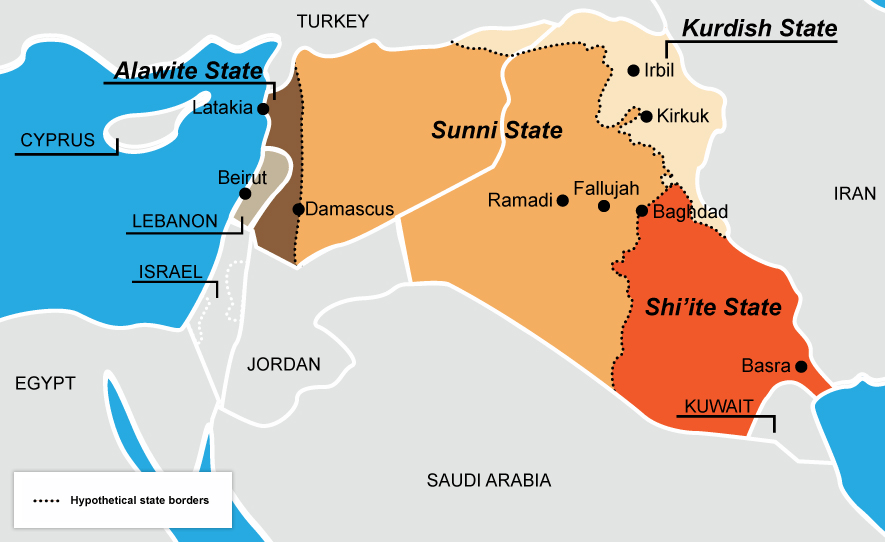
ISIS is the largest terrorist organization in the world, because it has moved beyond the traditional limits of terrorism, and it basically represents the Sunni parts of Syria and Iraq, it has its own oil fields, and that’s why ISIS wants to have a country too i.e. the Sunni parts of Syria and Iraq. Before the rise of ISIS the largest terrorist organization in the world was the Saudi Al-Qaeda, which was the queen of terrorism.

On the following map you can see a possible state for ISIS. With brown you can see the Sunni parts of Syria and Iraq, with orange the Shiite part of Iraq, with dark brown the Alawite part of Syria, and with beige the Kurdish parts of Syria and Iraq.

Map 2 A Possible State for ISIS (Sunni Syria and Iraq)


For Al-Qaeda I must say that it is not controlled by the Saudi King as many people might think. Al-Qaeda is a complex organization which has to do with the Saudi elites and the power game within Saudi Arabia. Osama bin Laden, the father of Al-Qaeda, was targeting the Saudi King too, and that’s why he could work with the Iranians too, even though Iran was a rival for Osama bin Laden too. See Breitbart “Iran Worked with Al Qaeda, Docs from Raid on Bin Laden Compound Show”, July 2015.

See also “The Alliance Between Iran and Al Qaeda”.

The Deutsche Welle article also says that the growing tension between Iran and Saudi Arabia will lead to growing tensions in African countries with Shiite minorities, and offers Nigeria as an example. In Nigeria the army clashed with the Shiite Muslims of Nigeria. Note that Nigeria is one of the richest countries in oil and gas, she is half Christian and half Muslim, and there are clashes between Christian and Muslims, and also between Sunnis and Shiites (Shia).

Articles

“Saudi-Iran row spills over into Africa”, January 2016

“Nigerian military attacks Shia group over blocked road, killing some”, December 2015

“Iran denies shipping arms to Islamist militants in Somalia”, February 2013

“How al-Qaeda and Islamic State are fighting for al-Shabaab affections in Somalia”, November 2015

“Iran Worked with Al Qaeda, Docs from Raid on Bin Laden Compound Show”, July 2015


Πέμπτη 7 Ιανουαρίου 2016

The Allies of Iran and Saudi Arabia

A very nice article from the Lebanese site Ya Libnan. The article offers a summary of the countries that have supported Saudi and Iranian after the recent crisis, due to the execution of the Shiite cleric by Saudi Arabia.


Saudi Arabia : Bahrain, Kuwait, United Arab Emirates, Jordan, Israel, Palestinian Authority (PA). In Yemen there is a civil war and the government of Yemen, which is backed by Saudi Arabia, supports Saudi Arabia while the Hoothi rebels, who are supported by Iran, support Iran.

Note : The Palestinian Authority is the socialist organization that was established by Yasser Arafat and runs the West Bank, and has many problems with the Islamist Palestinians of Hams who run Gaza..

Iran : Syria, the Shiite Government of Iraq, and Hezbollah in Lebanon.

The European Union accused Saudi Arabia for the executions.

The United States and Germany called both parties to show restrain. However, according to Bloomberg the Americans stance tilted a bit towards Iran.

Russia was neutral and offered to mediate between the two countries. Russia’s response shows the effect that the agreement for the Iranian nuclear program had on the Russian-Iranian relations. Before the agreement Russia would have clearly supported Iran.

The article gives Turkey as neutral, but I guess it has missed the recent developments. Erdogan said on Wednesday that the executions are an internal affair of Saudi Arabia, and that Iran should have prevented the destruction of the Saudi embassy in Tehran. In other words Turkey clearly supported Saudi Arabia in the end.

The article gives Oman as neutral, and it sounds reasonable, since Iran and Oman are promoting the underwater Iran-Oman-India pipeline.

For the article see:
“Saudi -Iranian dispute: A look at where countries stand”, January 2016

Τετάρτη 6 Ιανουαρίου 2016

Sunnis VS Shiites (Shia)

The following New York Times map shows with red the regions with Sunni majorities. and with blue the regions with Shiite (Shia) majorities.

Map 1 Sunni VS Shiite (Shia) Islam


Even though Sunni Muslims account for 80% of the Muslim World, or even more, there are four countries with Shia (Shiite) majorities i.e. Iran, Iraq, Bahrain and Azerbaijan. There are significant Shia majorities also in Afghanistan and Yemen. In Saudi Arabia Shia Muslims account for 10-20% of the population, but they are mainly located in the oil region of Saudi Arabia i.e. near the Persian Gulf (see map 2).

Map 2 Oil (black) and Natural Gas (red) of the Middle East

That means that if the Iranians managed to cause an uprising of the Shiite Muslims of Saudi Arabia, they could interrupt the Saudi production, and lower production would mean higher prices for the Iranian oil, and also increased market share for the Iranians. The current Saudi policy is to produce a lot of oil, in order to drive out of the market the American companies that produce oil from shale rock in United States, but also to weaken the Russians and the Iranians who are dependent on oil exports and fight Saudi Arabia in Iraq and Syria.

Turkey fights both Iran and Saudi Arabia, but in the January 2016 crisis between Saudi Arabia and Iran, over the killing of the Shiite cleric in Saudi Arabia, Turkey supported Iran, even though in a discreet way. Turkey would definitely want the overturn of the Saudi King, and his replacement by some members of the Muslim Brotherhood, which is an Islamist organization supported by Turkey and Qatar. But the low oil prices caused by the huge Saudi production are perfectly fine for the fragile Turkish economy. Turkey does not export any oil, like Iran and Russia do. On the contrary Turkey spends a great deal of money on oil imports.

The other day I was saying that according to the Financial Times the oil revenues of ISIS are approximately 700 million dollars, which is nothing compares to what Turkey has to pay for oil imports. And “Why Low Oil Prices are Good for ISIS”

Therefore, even if we accept that Putin is right, and Bilal Erdogan, the son of Tayip Erdogan, is buying oil from ISIS in the black market, there is no reason to assume that Erdogan would want high oil prices. Because high oil prices would finish the Turkish economy and himself. Turkey might want to see the Saudi King gone, like the Iranians do, but Turkey is very happy with the low oil prices which keep afloat the bubbled Turkish economy that has been created by the aggressive monetary policy that was followed by Erdogan and Davutoglu. See “The Socialist Myth of Economic Bubbles”

For the New York Times article and the map see:
“Behind Stark Political Divisions, a More
Complex Map of Sunnis and Shiites”, January 2016