Παρασκευή 27 Νοεμβρίου 2015

(Saudi Arabia VS Iran) + (Egypt VS Turkey)

A very good article from Foreign Affairs about the Saudi-Egyptian alliance. Egypt and Saudi Arabia are trying to jointly establish an Arab military force in order to counterweight the Arabs and the Turks. This Arab force will be mainly based on the Egyptian army and on Saudi funding.

Map 1 (Turkey VS Egypt) and (Saudi Arabia VS Iran)


Egypt and Saudi Arabia are the two most important Arab countries, with Egypt being the largest Arab country, and Saudi Arabia being the richest one. However the two countries significantly differ in their foreign policy, and that’s what the article is about. The main problem is that Egypt’s main rival is Turkey, while Saudi Arabia’s main rival is Iran, and this difference make it difficult to coordinate the foreign policies of the two countries.

The Egyptians were very pleased to see the Russians coming to Syria, while the Saudis were very unhappy with the Russian’s move. The reason is that Russia is an Egyptian ally, but Russia is a major competitor of the Saudis in the oil markets. Moreover Russia’s presence in Syria makes things harder for ISIS and Turkey, and that’s good news for Egypt, but at the same time the Russian presence strengthens the Syrian dictator Bashar al Ashad, a major Iranian ally, which is bad news for Saudi Arabia. ISIS and the Muslim Brotherhood are mainly supported by Turkey and Qatar, and Egypt has to fight ISIS and the Muslim Brotherhood in Libya, Gaza and the Sinai Peninsula, while the Saudis sometimes cooperate with the Turks against the Iranians.

Therefore Egypt needs the Saudi funding, and Saudi Arabia needs the Egyptian army, and both want to form an Arab military power to counterweight the Turkish and Iranian influence, but the Egyptians focus on Turkey and the Saudis focus on the Iranians, and that causes the foreign policy of the two countries to significantly diverge.

“Last Alliance Standing”, November 2015


England VS ISIS (Jeremy Corbyn)

I have mentioned many times England’s cooperation with Qatar in the energy sector. England imports from Qatar huge quantities of liquefied natural gas, and Qatar is also heavily investing in England. Therefore Qatar has significant influence over British politics. See for example Financial Times “UK warned over dependence on Qatar gas”, January 2012, and the Guardian “How much of London is owned by Qatar’s royal family”? , January 2014.

It is true of course that Russia has a lot of influence over British politics too, because the Russian oligarchs heavily invest in England too, and England and Russia are also cooperating in the energy sector. See for example New York Times “London’s Laundry Business”, March 2014, and the Independent “Gas imports from Russia's Gazprom giant to soar after new Centrica deal”, May 2015.


Qatar, an Islamist country, is buying political influence all over Europe, but it has a preference for left parties which do not hesitate to promote illegal immigration in Europe. Therefore a large part of the European left shows a lot of support for Qatar and its ally Turkey. Turkey is one of the countries that are very friendly towards ISIS, because she buys oil from ISIS. See for example Financial Times “Isis sells smuggled oil to Turkey and Iraqi Kurds, says US Treasury”, October 2014. Actually the Russians say that the son of Turkey’s President Tayip Erdogan i.e. Bilal Erdogan, is doing business with ISIS. See for example “Ankara's oil business with ISIS”, November 2015.

Now Russia and France are bombing ISIS in Syria, and the center right British Prime Minister David Cameron wants England to also participate in the military operations against ISIS. Naturally a large part of the European left gets very upset with the idea of bombing ISIS. Jeremy Corbyn, the new leader of the British Left, and leader of the opposition, is really against the idea of Britain bombing ISIS. But many members of his party are revolting against him and are openly supporting the Prime Minister David Cameron on the subject of ISIS. See Independent “Air strikes in Syria: Jeremy Corbyn faces Shadow Cabinet revolt over his opposition to British military action”, του Νοεμβρίου 2015.

This is great news because it can help curb communist propaganda which is rampant in Europe and the US. According to communist propaganda ISIS was created by the West. But if the West decides to cooperate against ISIS, communists will have to revolt against such decisions, like Jeremy Corbyn is currently doing. Therefore the unsuspecting and innocent voters who are subjected to communist propaganda will be surprised to see the west ready to bomb ISIS, and the European communists, who accuse the West for creating ISIS, actually protecting ISIS.

Moreover, many innocent European voters believe that European communists are still working with Russia, as was the case before the collapse of the Soviet Union in 1991. Things will become clear for them because Russia will be one of the leading countries fighting ISIS, and the European communists will be the ones who will be trying to protect ISIS.

Articles

“Air strikes in Syria: Jeremy Corbyn faces Shadow Cabinet revolt over his opposition to British military action”, του Νοεμβρίου 2015

“UK warned over dependence on Qatar gas”, January 2012

“How much of London is owned by Qatar’s royal family”? , January 2014

“London’s Laundry Business”, March 2014

“Gas imports from Russia's Gazprom giant to soar after new Centrica deal”, May 2015

“Isis sells smuggled oil to Turkey and Iraqi Kurds, says US Treasury”, October 2014

“Ankara's oil business with ISIS”, November 2015


Τετάρτη 25 Νοεμβρίου 2015

Why Turkey Downed the Russian Aircraft

If we accept what the US officials say i.e. that the Russian aircraft briefly entered the Turkish airspace but it was targeted while it was in the Syrian sky, Turkey’s decision to shoot down the aircraft seems somewhat extreme. What is even more strange is that the Turkish Prime Minister, Ahmet Davutoglu, said that the decision to shoot the Russian aircraft was a political one. He did not say that it was a mistake or a miscalculation etc. He assumed full responsibility, while he did not have to do that.

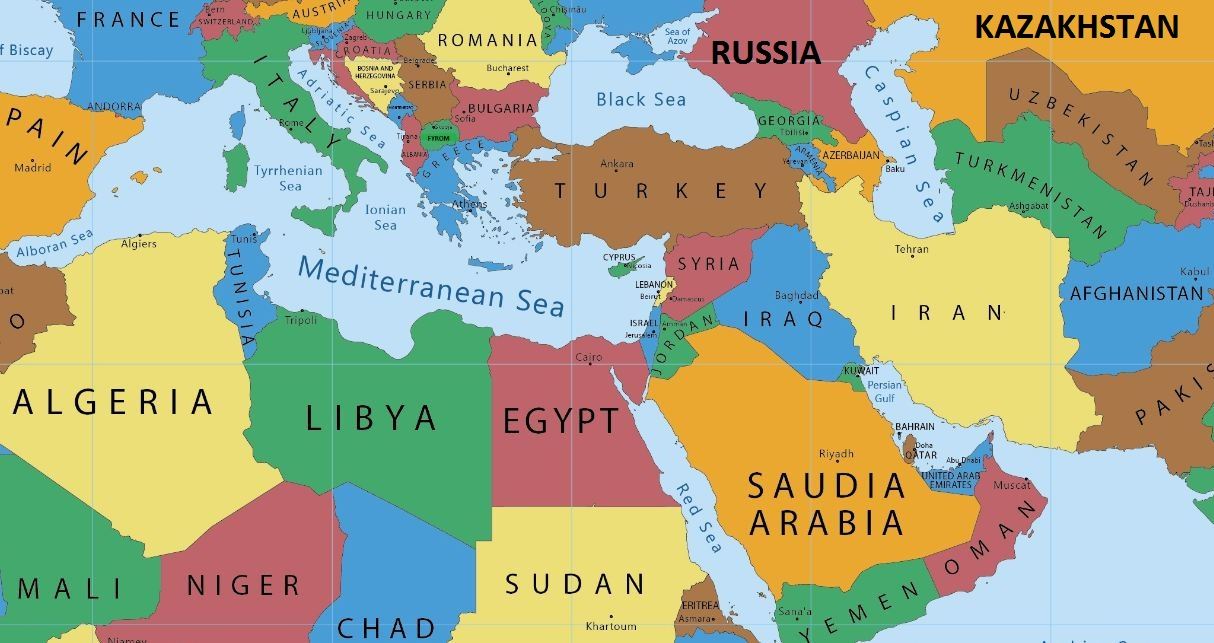
Map 1 Middle East


Therefore we can assume that for Erdogan and Davutoglu it was a strategic move to target the Russian aircraft, and therefore they were sure that this would benefit Turkey. At least they were sure that it would not hurt Turkey. But how can a country expect to improve her geopolitical position by attacking a Russian aircraft? There is only one explanation. After the Paris terrorist attacks of November 2015, an anti-ISIS front was formed in Europe, and France and Russia started jointly bombing ISIS in Syria. England also gave France her military bases in Cyprus, and the British Prime Minister said that England should also bomb ISIS.

Until yesterday that was convenient for the Americans too. Remember that Donald Trump said that the US should leave it to Russia to attack ISIS in Syria. Donald Trump is a candidate for the Republican Presidency, the polls show him leading the race, and if he wins he will be a candidate for the American Presidency in 2016. Therefore what was happening in Syria was convenient for the US, because American and Turkish interests diverge in Syria, due to the Kurds of Syria, and due to the improvement in the American-Iranian relations. After all for the United States Syria is less important than Iraq.

As long as the Russians and the French were bombing ISIS in Syria, Erdogan and Davutoglu could not complain. At least not officially since they cannot admit that they are somehow related to ISIS. By targeting the Russian aircraft the Turks are causing cracks in the anti-ISIS coalition, because if tension rises between Russia and Turkey the Americans will have to support Turkey, which is their NATO ally, and that will bring the US against France and England, which are also NATO members. This can only hurt the anti-ISIS momentum, because neither the US wants to confront England and France, nor England and France want to confront the US.

If the US decides to align itself with Russia, England and France against ISIS i.e. against Turkey, Turkey will be very weak, and her only option would be to align herself with Russia. Turkey would have to accept the discounts on energy prices offered to her by Russia. Therefore Turkey would have to forget her ambitions about becoming and independent energy hub which would send the natural gas and oil of the Caspian Sea and the Middle East to Europe, and would have to become for Russia a second Ukraine, which would simply send the Russian gas to Europe. But that would leave Europe dependent on Russia, and that’s something that the US and the European Union do not want.

Map 2 Russo-Turkish Rivalry


 Becoming an independent energy hub is Turkey’s most important geopolitical ambition. If the United States were to undermine this ambition by aligning itself with Russia, France and England it would be like sending Turkey to Russia’s arms. And I do not thing that the Americans are willing to do the same mistake they did with Iran. Iran and Russia are two natural competitors, but they became allies because of the confrontation between the US and Iran. The Turks are not the ally they used to be for the Americans, but they are Russia’s natural rival.

Therefore the rising tensions between Russia and Turkey right now clearly help Turkey, and that’s why Davutoglu did not hesitate to say that targeting the Russian airplane was a political decision. Russia should remain as calm as possible. The Russians should throw some fireworks to satisfy the Russian public opinion, but they should not try to cause further tensions, because that would cause further crackings in the anti-ISIS coalition.

However there is a further problem. The rising tension between Russia and Turkey might have hidden benefits for Russia too. Because as tension rises the Americans will have to support the Turks against Russia, and the French will have to support Russia against Turkey, due to the Islamist attacks against France. Attacks against France could increase if tensions between France and the Jihadists of the Middle East and North Africa rise. That would cause a further division within NATO. Destroying NATO is one of Putin’s main concerns, and  in the past he has managed to do that with Germany.

If France finds herself against the United States there will not be much NATO left, and that would be a great victory for Putin. Therefore there might be some hidden benefits for Russia too from the rising tensions between Russia and Turkey. The truth is that I am not sure about the cost-benefit analysis for Russia. But I am sure about Turkey. You do not attack a Russian aircraft because it entered you airspace for a few seconds. You do it because you think that it will somehow benefit you. Davutoglu is a great strategist and no one questions his genius. Of course I do not mean to say that Turkey wants war. Turkey is just playing a very dangerous game. Nobody wants war. Wars happen because of contradicting interests but nobody ever wants them.

Τρίτη 24 Νοεμβρίου 2015

NATO – What a Mess

If Russia decides to attack Turkey, after the Russian aircraft was downed by Turkey (24.11.2015), NATO will have to step in and protect Turkey, because Turkey is a NATO member. The problem is that France, together with Russia, is also bombing Turkey in Syria. Actually France is bombing ISIS in Syria, but everyone knows Turkey’s connection with ISIS.

But France is a NATO member. England, another NATO member, has offered France her airbases in Cyprus, so that France can bomb ISIS i.e. attack Turkey. The British Prime Minister, David Cameron, also said that England should bomb ISIS too i.e. attack Turkey along Russia and France.


Now, if Russia decides to attack Turkey directly, the United States i.e. the leader of the North-Atlantic Alliance, will have to ask its allies, i.e. England and France, to jointly protect Turkey from Russia. But England and France are bombing ISIS i.e. they are attacking Turkey. NATO, what a mess…

Κυριακή 22 Νοεμβρίου 2015

The French-American Relations in Syria

As you can read at the following articles from the Los Angeles Times, the French are asking the Americans to cooperate with Russia in Syria against ISIS. According to the article the Americans require that the Russians commit to let the Syrian dictator Bashar al Assad to go before there is an alliance between US and Russia against ISIS in Syria.

Map 1


What the Americans are really asking from the Russians is that they distance themselves from the Iranians in Syria. The Iranians and the Russians are already competing for influence at the Syrian coasts of the Mediterranean Sea, which can send to Europe the Iranian oil and gas. But the Russians are a bigger fish than the Iranians. The Iranians mainly use Russian weapons. If the Russians decide to let Assad go they will hurt their relations with the Iranians, and they will be able to guarantee to the Turks and the Arabs of the Persian Gulf that the Iranian oil and gas will not reach Europe through Syria.

Russia could be a credible guarantor for Turkey and the Arabs, because the Arabs and the Turks know that the Iranian oil and gas would also hurt the Russians if it was to reach Europe. The Russian state own giants are mainly exporting to Europe. But if the Russians decide to block Iran in Syria, the Iranians might send their oil and gas to Europe through Turkey to retaliate, while for the Iranians the priority is to send them to China through the Pakistan-China Economic Corridor which is promoted by China.

Therefore, even though I don’t know what will happen to the distant future, for the near future the Russians can ask the Iranians to forget the European markets, and there is a high chance that the Iranians will do it. And if the Russians are in good terms with the Iranians, and at some point the Iranians decide to send oil and gas to Europe through Syria, the Russians could hope that the Iranians will prefer Russian over Western companies. Actually the plan was that Gazprom would construct the Iran-Iraq-Syria pipeline, which was stopped by the Turkish and Arab attacks in Syria and Iraq. See “Who is Responsible for the War and the Immigrants”.

Map 2


But if the Russians decide to let Assad go, and to be more accurate if the Russians agree to block the Iranians in Syria, the United States could fight with them ISIS,. Because if the Turks and the Arabs of the Persian Gulf knew that Syria was not under Iranian influence they would be open to discussions, and they could restrain the Islamists militants they support in Syria.

But it is very difficult for the United States to cooperate with Russia against ISIS if Russia does not accept to distance herself from Iran. Because under such a scenario it would be like the Americans were aligning themselves with the Russians against Turkey. The Americans target ISIS to support the Kurds of Syria, but the fight between ISIS and the Kurds is a problem between USA and Turkey. Russia is not really involved in the competition between Turkey and the US over the Kurds of Syria and ISIS.

However if the Americans were to cooperate with Russia against ISIS, before any commitment on Assad, there would be an American-Russian alliance against Turkey. Under such a scenario the Americans would face the danger of pushing Turkey in Russia’s arms, even though Turkey and Russia are natural competitors. The same thing happened with Russia and Iran, two natural competitors, who became allies due to the confrontation between the US and Iran. And the Americans need Turkey.

It is very difficult to find a solution in Syria. If the Russians and the Americans cooperate against ISIS without the Russians distancing themselves from Iran, the relations of the United States with the Turks and the Arabs will be hurt. On the other hand if the Russians and the Americans cooperate against ISIS with Russia distancing herself from Iran in Syria, the Russo-Iranian relations will be hurt. There is a very difficult situation in Syria.

The French ask the Americans to cooperate with the Russians in Syria, but things are much easier in Syria. The French have very problematic relations with Turkey, and it is a lot easier for them to target ISIS. Moreover if they target ISIS their Saudi allies would not be very unhappy, because the Saudis and the Turks jointly fight Bashar al Assad in Syria, but they also fight each other. The Turks are buying oil from the oilfields controlled by ISIS in Iraq, and some of this oil is also exported from the Turkish port of Ceyhan, and that is not good for the Saudis. Also the French are the first ones to ask for Assad to go, therefore their Arab allies should not be disappointed.

In addition Tayip Erdogan, Turkey’s Islamist President, wants Turkey to be the leader of the Sunni Islamic World, a role played by Saudi Arabia until the Islamists took control of Turkey in 2003. Tayip Erdogan is for Saudi Arabia an Islamist version of Gamal Nasser. See “ The Intra-Arab War for Oil : 1950-1970”.

For the Los Angeles Times articles see:
“France seeks U.S.-Russia unity in coalition against Islamic State”, November 2015

Map 3 Oil Fields (black) and Natural Gas Fields (red)


Πέμπτη 19 Νοεμβρίου 2015

The British Guardian Accuses the Turkish President for Supporting ISIS and for the Paris Attacks

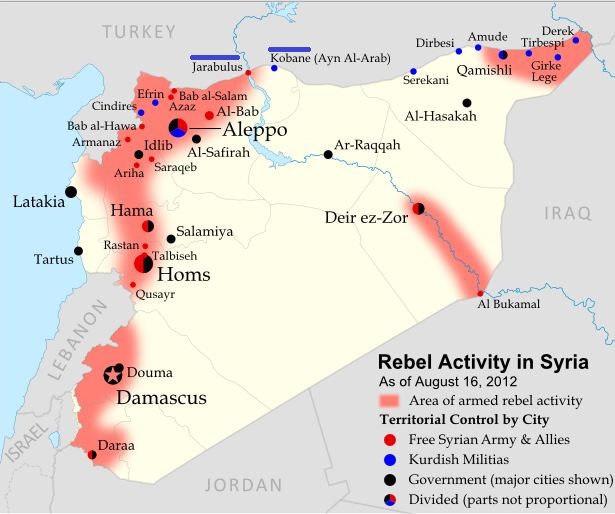
A very interesting article from the Guardian, titled “Turkey could cut off Islamic State’s supply lines. So why doesn’t it?”, November 2015. The article is about the connection between the Turkish President, Tayip Erdgoan, and the Islamic State. The Guardian says that the Turkish President could very easily cut off the supply lines of the Islamic State at the Turkish-Syrian borders but he chooses not to do so. When the Kurds won the battle of Kobani, and they were ready to take Jarabluz too, Erdogan threatened to send in Syria the Turkish army, and the Kurds had to stop. See map 1.

Map 1 Kobani and Jarabluz


According to the Guardian, if the Kurds had taken Jarabluz, the supply lines of ISIS would have been cut, and soon the capital of ISIS i.e. Raqqa, would be lost too. I guess the article means that Raqqa would have come under Shiite control.

Map 2 Regions Controlled by ISIS


You can see at the above map from the Financial Times, that northern Syria is mainly controlled by the Kurds of Syria i.e the regions I have marked with yellow, and there is only a small part through which ISIS is connected to Turkey.

During the war of Kobani I was under the impression that Erdogan was afraid that the Kurds of Syria (YPG) could be connected with the Kurds of Northern Iraq (KRG), and if they could reach the Mediterranean Sea they could together export the oil and gas of Northern Iraq. But that was not what Erdogan was worried about. Erdogan was worrying that the supply lines of ISIS would be cut off, and that the lines through which ISIS sends its oil to Turkey would be cut off too. Some of the Iraqi oilfields have come under the influence of ISIS, and ISIS is exporting some of that oil to Turkey. See also “The Oilfields of the Islamic State”

The Guardian also says that Erdogan is using the argument that the Kurds of Syria (YPG) are connected to the Kurds of Turkey (PKK), and the PKK has carried out many terrorist attacks in Turkey, and therefore the YPG is also considered by Turkey as a terrorist organization. I have to say that Erdogan is right about that, because the YPG and the PKK are indeed sister organizations.

The article also says that Erdogan supports in Syria the Saudi terrorist organization Al Qaeda. I have to say that Al Qaeda is funded by some parts of the Saudi elites, and it also targets the Saudi King, and is partially supported by Turkey and Iran too. Iran would be very glad to see the Saud family gone, and Turkey has many problems with the Saudis too. However in Syria Al Qaeda is also fighting Iran, and therefore she is very useful for Turkey. For Iran and Al Qaeda things are more complicated. See “The Alliance Between Iran and Al Qaeda”.

The Guardian also says that the recent terrorist attacks in Turkey, which were attributed to ISIS, in a mysterious way targeted the activists who supported the HDP party, which is an alliance between some left groups and the Kurds of Turkey. What the Guardian is basically saying is that Erdogan was behind these terrorist attacks in order to target the HDP. It does not say that explicitly but is says it implicitly. This is the relevant paragraph. The paragraph is also saying that the police was making it difficult for the ambulances to take the injured.

9th Paragraph
There followed a series of increasingly bloody terrorist bombings inside Turkey – in the cities of Diyarbakir, Suruc, and, finally, Ankara – attacks attributed to Isis but which, for some mysterious reason, only ever seemed to target civilian activists associated with the HDP. Victims have repeatedly reported policepreventing ambulances evacuating the wounded, or even opening fire on survivors with tear gas.


In the first paragraph the Guardian accuses the leaders of the G20 who visited Turkey after the recent terrorist attacks in Paris, because Erdogan is supporting the militants of ISIS, and therefore he is responsible for the attacks.

For the article see
“Turkey could cut off Islamic State’s supply lines. So why doesn’t it?”, November 2015

A New Role for Russia in Syria?

A very nice article from the Wall Street Journal, about Russia’s new role in Syria, titled “U.S. Eyes Russia-Iran Split in Bid to End Syria Conflict”, November 2015. According to the article, after the Paris terrorist attacks of November 2015, there is an increasing pressure on the United States and Europe to cooperate with Russia in Syria against the Islamic State and ISIS. France is very active in diplomatically pushing for a coalition between France, United States and Russia against ISIS in Syria.

Map 1


According to the article, the Americans, the Europeans, the Israelis and the Arabs, would all like to see Russia distancing herself a bit from Iran in Syria. And indeed, according to WSJ the Russians are distancing themselves a bit from Iran, since they are discussing the possibility of the Syrian dictator Bashar al Assad stepping down, while Iran does not accept this scenario. The article also mentions that during the previous centuries Russia and Iran have been traditional rivals, especially in the region of Caucasus.

On the other hand, according the WSJ, the Americans and the Europeans are not sure whether the Russians are indeed serious about distancing themselves from Iran, because the Russian Minister of Foreign Affairs, Sergey Lavrov, does not accept any precondition on Assad’s removal for an end to be reached on the Syrian conflict. But I believe that’s a very reasonable reaction from the Russians, because the Russians would probably be willing to jeopardize their relationship with the Iranians only if they could sort things out with the West, but that has not happened yet. But despite the American and European doubts about the Russian stance over the Assad regime, the WSJ says that there is a growing pressure in the United States and Europe to form an alliance with Russia in Syria.

Map 2


According to WSJ, Putin met with the Saudis and the Israelis, and the Saudis requested from him to let Assad go, and the Israelis requested that Russia prevents the Iranians and the Lebanese terrorist organization Hezbollah from using Lebanon and Syria to attack Israel.

Map 3 Oil (black) and Natural Gas (black) Fields


Therefore we see that with the large Russian military presence in Syria, an enhanced role for Russia might be a good thing for the Americans, the Europeans, the Israelis and the Arabs. It might even be positive for the Turks. Only the Iranians would be hurt under this scenario.

The Arabs of the Persian Gulf

For the Arabs of the Gulf, especially for the Saudis, an enhanced Russian influence in Syria will ensure that Syria is not under Iranian control. And the main Saudi rival is Iran and not Russia. If Russia did not exist in Syria, Syria would come under Turkish, or Iranian or Saudi influence. However it is more likely that Syria would come under Turkish or Iranian influence rather than the Saudi one. Therefore Russia might be the best feasible outcome for Saudi Arabia in Syria, given that both the Russians and the Saudis will be hurt if the Iranians and the Iraqis sent their oil and gas to Europe through Syria.

The Saudis also have many problems with the Turks, because from 2003 Turkey became an islamist country, and started claiming the leadership of the Islamic World, held until then by Saudi Arabia. Becoming the leader of the Caliphate would also give Turkey a greater role over the oil and gas of the Persian Gulf. See “The Intra-Arab War for Oil 1950-1970”.

Of course one could argue that in 2011 the Russians, actually Gazprom, proposed to Iran and Iraq to constructed the Shiite (Iran-Iraq-Syria) pipeline, and this pipeline would hurt the Saudis. That’s true, but the only reason that Russia proposed this pipeline was because she wanted to prevent the Sunni (Qatar-Turkey-Europe) pipeline. See “Who is Responsible for the War and the Immigrants”.

In reality the Iranian and Iraqi oil and gas would hurt both the Russian, who provide a large part of the European oil and gas imports, and also the Saudis, who provide a smaller part of these imports. The Russians and the Saudis would prefer that Iranian and Iraqi oil and gas would not reach the Mediterranean Sea through Syria.

Israel

For the Israelis, under certain conditions, an enhanced Russian role in Syria could be a blessing. I repeat under certain conditions. The Israelis have a much better relationship with the Russians than they have with the Iranians and the Turks. The Israelis are basically at war with the Iranians and the Turks, with the Iranians having as an official policy the annihilation of Israel. This is not an official policy for Turkey, but Erdogan has also said that the Muslims must march to Jerusalem. Therefore, at least for now, it would be much better for the Israelis if the Russian are in charge in Syria, as long as the Russians are a bit distanced from Turkey and Iran. That way Russia could guarantee Israel that the Iranians and Hezbollah would not use Syria to attack Israel, and Russia and Israel could fight ISIS together in Syria. That’s of course an ideal scenario because Russia needs Turkey and Iran, but maybe Russia and Israel could meet somewhere in the middle.

Turkey

For Turkey Syria is very important because Iran can send oil and gas to Europe through Syria, and that would undermine Turkey’s ability to ask from Iran higher discounts, and also cooperation of Iranian and Turkish companies in the Iranian energy projects. It is true that Turkey would prefer to control Syria herself, but at least Turkey knows that Russia would be hurt too if the Iranians used Syria to send oil and gas to Europe. Thus, under the current threat of facing an alliance of Russia, United States and France in Syria, Turkey might have to compromise with a solution that would allow for a greater Russian role in Syria. In Syria the Russian-Turkish interests are closer than the Turkish-Iranian or the Russian-Iranian interests. There is already a lot of tension between Turkey and France, and we saw that when the Turkish fans boo the one minute of silence for the Paris victims. The Turkish fans were also shouting “Allahu Akbar” , which is very often heard in videos released by ISIS. See “Turkey football fans boo and chant 'Allahu Akbar' during silence for Paris victims”, November 2015

Map 4


The United States

Syria is a lot less important than Iraq for the United States. In Syria the American interests seem to be closer to the Russian rather than the Turkish ones. For the United States the ideal situation would involve the construction of both the Sunni (Qatar-Turkey) and the Shiite (Iran-Iraq-Syria) pipelines, so that as much oil and gas as possible would flow in the global markets. But it is impossible that both these pipeline networks are constructed, because the party controlling the region would prevent the other side from constructing the competing network.

Actually it seems that currently none of these pipelines can be constructed. Therefore it does not seem that the main problem for the United States is the construction of two pipelines which probably cannot be constructed. But if a solution is reached in the Middle East, and there is peace, the United States could transfer military forces from the Middle East to the Asian side of the Pacific Ocean, which is at the moment the most important region for the United States. The United States are also facing China in the South China Sea, because China is trying to militarize the region ignoring the other countries of the South China Sea. The Malacca Straits are the second most important choke point in the world, second only to the Straits of Hormuz.

If the United States reach an agreement with Russia in the Middle East, they could share the military cost of safeguarding the Middle East. Until now it is mainly the United States that safeguarded the Middle East and the safe flow of oil in the world markets. Therefore the US would be very happy if Russia could carry some of the military cost. That is of course if the United States could reach an agreement with Russia. I believe the US should allow Russia to have the upper hand in the Middle East, and ask something in return in Europe or Asia.

Map 5

 Iran

Iran’s dream is to reach the Mediterranean Sea. The increased Russian influence in Syria might therefore be a problem for Iran. However how could Iran stop this scenario, if Russia, the United States, France and Turkey agreed? Until now Iran could fight the United States because it was backed by Russia. Iran is mainly using Russian weapons. How is Iran going to attack the US if Russia and the US are together in Syria? And I don’t thing that China would have a motive to help Iran in Syria, and go against everyone else. The Chinese, like the Americans and the Europeans, are major oil and gas importers, and they want peace in the Middle East, so that oil and gas can flow freely and most importantly at low prices.

For the Wall Street Journal article see
“U.S. Eyes Russia-Iran Split in Bid to End Syria Conflict”, November 2015.